Photography and Travel Blog

Author: Maggie Page 5 of 36

Makgadikgadi

The journey here was pretty straightforward, although long. An 11 hour flight from London to Johannesburg, 3.5 hour layover, 1.5 hour flight to Maun and then a 45 minute light aircraft to Jack’s Airstrip in Makgadikgadi. We are travelling light with just hand luggage so it’s all pretty easy. Nobody else is flying to our camp so it is just Paul and I in a tiny 4 seater plane. I get to sit in the co-pilot seat. Cool!

Unusually Jack’s Airstrip has a little reception tent where we are offered snacks and lemonade before the 15 minute drive to the camp. It also has surprisingly good toilet facilities. Generally these remoter airstrips just have a bush!

We are staying at Camp Kalahari for the next three nights. We are offered more food and shown to our tent for a brief freshen up before an afternoon game drive. We travel no more than a few hundred yards when we encounter a huge male lion with two lionesses. They have full stomachs and are lazing in the shade, as is the norm in the daytime heat.

The male has a broken lower tooth which cannot improve his temperament.

He is very interested in one of the females and is clearly looking to mate with her. She makes it very clear that she is not interested.

We leave the lions and drive towards the salt pan where the zebras and wildebeests are plodding in single file in the hunt for water and any uneaten vegetation. This is just the start of the zebra migration, which is one of the largest mammal migrations involving 20000-30000 zebras and similar numbers of wildebeest. The wind starts to pick up. Initially visibility is not too bad …

… but by the time we arrive at the salt pan dust is flying everywhere making it hard to see and breathe and keep your hat on! However it does make for some interesting and enigmatic photographic opportunities.

Despite the challenges of the weather we are delighted to be driven to a small rise to see sundowners have been setup. We decide to brave the elements in the interest of not appearing rude!

We return to camp for supper and then an early night after our long travel day. However sleeping is a challenge. The wind is howling and everything on our tent rattles and clangs. The tarpaulin flaps noisily, but far worse are metal poles that bang loudly every time you are dozing off. Having finally gained a little sleep I am woken by the lions roaring in the distance. Surprising I can hear them over the din of the tent!

We are woken at 05.00 with tea, biscuits and orange juice. The wind has dropped, it is slightly overcast and the air is cool. I am very excited because we are going to visit meerkats this morning.

This particular mob has been habituated to humans and is where the film-makers come. As with all wildlife there are no guarantees and sometimes the animals just don’t want to co-operate. But not today. Boy are we in for a treat. We drive to meet our guide and spend two glorious hours in the company of these little guys.

Meerkats use humans as viewing platforms. Our guide sat down and immediately a meerkat climbed on his shoulder. Paul sat next to him but made sure he was higher, I then did likewise and the meerkat moved between us all. Its fur tickled my nose. It was so clean and fluffy and heavier than I expected, resulting in the meerkat almost pulling my hat off as it clambered up.

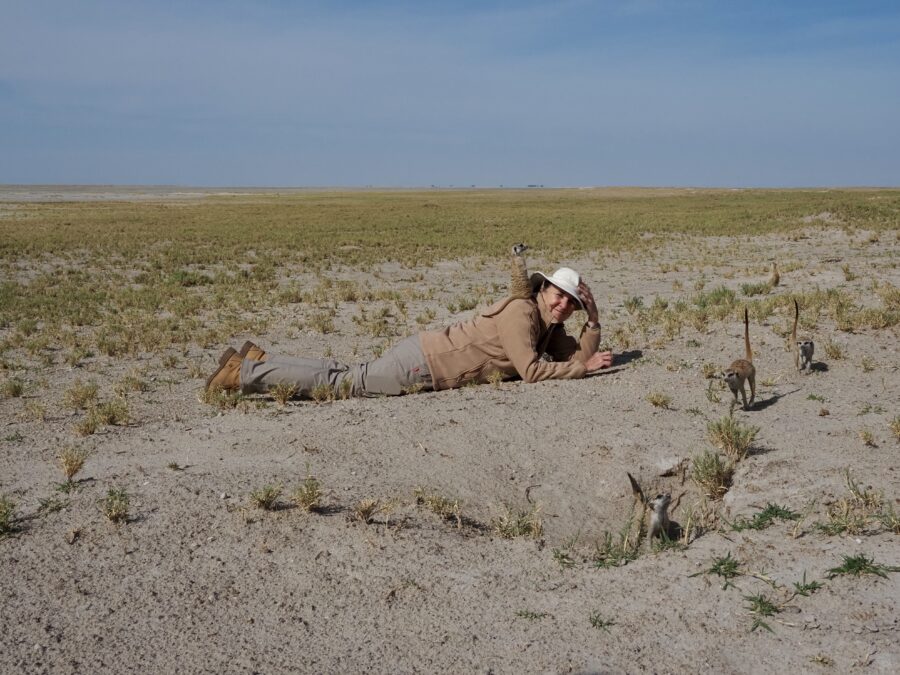
We follow the meerkats on their morning forage for grubs and scorpions. I lie on the ground to try and capture eye level shots and instantly a meerkat climbs on my leg, runs up my back annd onto my shoulder. This is truly the most incredible and privileged experience!

The whole day is amazing. A veritable feast of animal encounters…..

So much life here in the desert!

Our day finishes with a walk with the San Bushmen to learn about some of their survival skills.

It was very interesting. They tells us they burn elephant dung, crush the ash and use it to cure aches and pains. It makes sense. The elephants eat all types of plants and many have curative powers.

We learn how they dig up huge tubers to extract water. They scrape the flesh, roll it and squeeze the water into their mouths. Afterwards they replant the unused part which seals itself with latex and regrows.

They show us how to make a snare for catching guinea fowl…

…and how to make fire

They then play a game a bit like rock/paper/scissors except it is incredibly fast and causes great hilarity amongst them. They are wonderfully warm and hospitable people and I hope that they can continue to live their ancient lifestyle for years to come in our modern world. Then it is time for supper and bed.

We’re up at 05.00 for another astonishing day. The migration herds are really increasing in numbers. On our way to stake out the waterhole we see a southern black korhaan, a bat-eared fox, warthogs, a yellow mongoose, lots of helmeted guinea fowl and white backed vultures to name but a few.

At the waterhole the zebras are being pretty aggressive.

There are a lot of animals and not much water. We eat breakfast whilst watching the animal interaction.

The morning keeps giving with wonderful vistas that the camera does not do justice to…

…and ostriches, warthogs, ground squirrels, elephants, steenbok, kudu, secretary birds, yellow-billed hornbills and more grace us with their presence…

The afternoon drive sees us re-visiting the waterhole and watching the zebra and wildebeest interaction.

We continue on our way spotting a newly born zebra and mother…

…and up onto the pan where the herds are overnighting…

…the horizon extends in all directions and we have a 360 degree view of the curvature of the earth. Quite something and a slightly surreal experience. What a place to drink sundowners!

Spring hares (aka African kangaroos) abound on our drive back to camp.

Our final morning drive before our flight to our next camp provides more incredible encounters. Initially the morning is quiet, but there are lots of birds around as well a scrub hare.

We stop for coffee at a small water hole. Zebra and wildebeest are joined by stray cattle which frequently get killed by lions. Sand grouse drink and a yellow kite threatens them. There is lots to watch while we stretch our legs.

We were asked when we arrived whether we should like to go out horse-riding. I felt my riding skills were not good enough in case we met something fierce. Clearly my instincts were correct. We see vultures landing and find them, together with several jackals, feeding on a recent lion kill – a dead horse which still has its rope attached. Why would anyone want to ride a lion’s meal? No thank you!

Final Adventures

Daybreak finds us anchored in Home Bay, Princess Royal Island. We are heading out on a pre-breakfast excursion to walk through the rainforest and to explore the shoreline. This is a wide open bay with skeletal trees washed up along its edges.

This is an area where there has not been logging so the forest is in a much more natural state. We enter the forest and although the ground is soft, thick and mossy, the reality is that the soil is very shallow. Probably only a metre or so deep. It is quite remarkable that such large trees manage to remain upright.

After a short walk, we return to the beach. I concentrate on photographing the small things.

I could easily spend the whole morning here. There is lots to see. Sandpipers hunt amongst the pebbles and flocks of sea birds swoop and flock above the water.

Too soon we must return to the tender. However there is a problem. The water is shallow and it has run aground. People have to disembark to make it lighter. And there is a deal of pushing and shoving.

The real problem though is that the tender cannot come in close. This means that we have two options. Wellies off and wade barefoot or wet boots. I roll my trousers up, take my boot off and put my foot in the icy water. As soon as I step on the bottom I realise my mistake. Everything is covered in barnacles. There is no way I can walk barefoot. Nothing for it but to put my welly back on and let it fill up with water as I wade to the boat. It’s an adventure and fortunately Cascadia has a good welly stock and issue me with a nice new dry pair.

A late hot breakfast is eaten whilst we depart and head down the aptly named Whale Channel. There are whales everywhere – mainly humpback but we do also see two fin whales though not close enough for photos. There is a tender excursion before lunch in which we see more whales. Two make us jump by surfacing and blowing out very close to the boat.

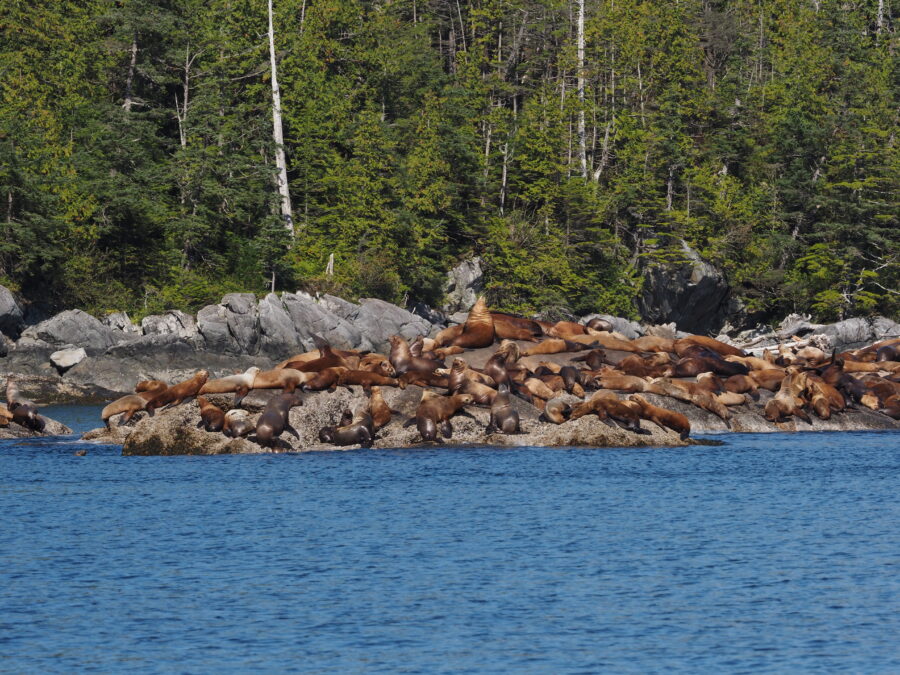
We continue to Ashdown Island where hundreds of Steller’s sea lions laze on the rocks, squabbling and honking noisily as they fight for the limited space.

This is a busy day. We head back for lunch. Cascadia makes passage to the Estevan group of islands. We are now on the Pacific edge and away from the mountains and fjords. There is a swell on the ocean that we have not experienced before. The clouds give way to clear blue skies.

We then make another sortie to the Hickey Islands. It is beautiful here – isolated islands with a hazy mountain backdrop. However navigating between the islands can be tricky. The channels are largely uncharted and there are huge kelp beds to negotiate. Avoiding wrapping kelp around the prop requires alertness and slow travel.

There is lots of bird life though, as ever, it is not that easy to photograph them from a moving boat. No reason not to try though…

We make a landing on a very boulder strewn island. It takes a few attempts to successfully moor up close enough to disembark without flooding our boots again. We all manage part from Olivia, who is in the other boat and as she steps onto a boulder slips and gets thoroughly wet trousers. No injury though and we all think it is very funny.

We collect plastic debris and clamber over the rocks and driftwood. It is good to stretching our legs. Tomorrow is our last full day and will largely be spent making our way back to Kitimat. In the morning we have an interesting talk on the life cycle of salmon and the ecological challenges that they now face. In the afternoon we make our final excursion in the tenders into Foch Inlet. I decide to not take the camera and just enjoy the scenery… It is pretty impressive.

There is of course the obligatory waterfall…

…and creeks feeding the lagoon with flat areas that potentially could afford us a view of bears or wolves. We see none but there are loads of birds. Bald eagles soar and kingfishers flit along the shoreline.

Our farewell dinner is an extra special one with white table cloths and four courses instead of the usual three. The starter of seared albacore tuna and the spot prawn risotto to follow deserve special mention. Delicious.

Dinner is a fairly boisterous affair and is followed by a slide show of the trip which hopefully we shall be sent a link to in due course. A great keepsake.

On our last morning the weather has deteriorated and it feels very autumnal. There is low cloud and persistent rain. This is the right day to be leaving.

I have enjoyed our week on Cascadia, although it was perhaps not all I had hoped it would be. I expected to have more mammal encounters. The animals are here but very difficult to find in the dense forest. Nonetheless, there were some very special moments and as I read back through the blog I do not feel in the least bit short changed. I must offer a huge thank you to all the crew who looked after our every need and made the trip so pleasurable.

The map above plots our route and we have explored everything from the narrowest inlets, steep sided fjords and pretty coastal islands. This is a spectacular part of the world and definitely worth visiting.

Bears and Humpbacks!

We have anchored on the west coast of Gribbell Island. The weather is set fair and this promises to be a rather special day. The plan is to try and have a really good bear experience and maybe even encounter a spirit bear.

The spirit bear (or kermode bear) is a sub-species of the American black bear and is not an albino. The white fur comes from a recessive gene (two black coloured bears can parent a white cub if they both carry the recessive gene). There are between 100 and 500 white black bears. A male can weigh more than 225kg and a female is much smaller at 135kg. It is thought that the light colour gives these bears an advantage when fishing, as they are harder to see against the bright sky. On average they catch 35% more fish than a black coloured bear.

We are eager for action. We meet Marvin (who belongs to the Gitga’at people) who will guide us and take us to a special stretch of river where bears are regularly seen. He lives in Hartley Bay which is a First Nations community.

It is home to the Gitga’ata (sometimes Gitga’at or Gitk’a’ata), which means “People of the Cane.” The Gitga’at are members of the Tsimshian nation. As of 2013, 167 band members live on the reserve and 533 members live off reserve in Prince Rupert, Vancouver or other regions. A distinctive feature of the community is the wooden boardwalks which are used rather than gravel roads.

WIKIPEDIA

We step ashore, scrambling over 20 feet of boulders, and take the 20 minute walk along an old logging road. It is now becoming overgrown with alders and a variety of shrubs, mosses and ferns, but there is nevertheless a clear and easy path to follow. We hear wolves howling. Goodness – if we saw them this would be truly amazing! Apparently, they are occasionally seen here but are very wary of people. It is unlikely that they will put in an appearance. The going is easy apart from a short steep stretch down to the river but fortunately ropes have been installed to ease our passage. There are three designated viewing places along the river bank, comprising 2 platforms and for the photographers – camping chairs along the path.

We sit quietly, watching and waiting. The wolf calls are growing louder and one of Marvin’s spotters says a wolf is approaching. How exciting! But it is not too be. We have clearly been seen and the wolves have distanced themselves. We sit quietly for several hours. Time to photograph the mosses and ferns.

It is not particularly cold but sitting still for a long while does eventually let a chill creep in. We are delighted to be handed a steaming mug of hot chocolate. It tastes good.

Small birds flit among the undergrowth and provide some camera target practice. A family of dippers entertain us with their bobbing movement as they hop from pebble to pebble in the river, catching small insects and larvae.

Then at last there is action. Marvin says a bear has been seen and is heading our way. This time we are not disappointed. A black body emerges from the undergrowth a couple of hundred metres upstream.

It only puts in a brief appearance but it shows promise. Now we are all re-focussed. Maybe another hour passes and we go back to capturing dippers, kingfishers and watching the numerous salmon battling their way upstream in the too shallow water.

Then another bear appears – maybe the same one. She is upstream but slowly and steadily heading towards the first platform.

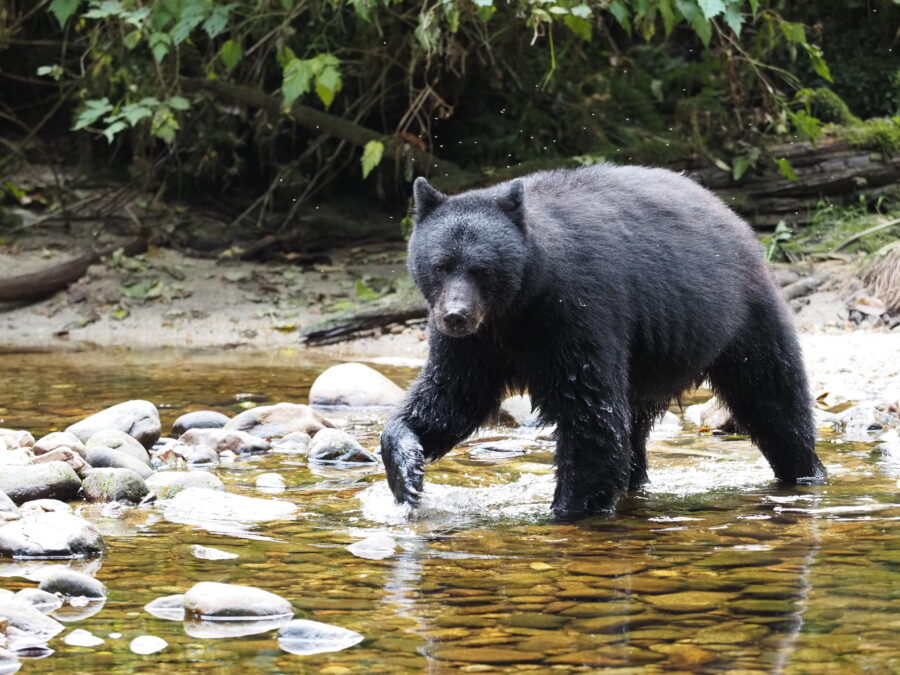
We click away, trying to bag as many shots as possible. You have no idea until after the event just what the quality of the encounter will be. Pixels are free so we just keep shooting. The bear pauses to glance up at her audience… I wonder what she is thinking.

She passes the platform and makes her way into the stream and towards us, searching for fish as she goes.

I have moved position and moved lower and closer to the water’s edge. My comfort is that Marvin is sitting next to me and I reckon if he thinks I am safe, then I probably am. However, my heart is pounding and the black bear just keeps coming. She is crossing the stream and walking directly towards me – 12 feet away. What the heck am I doing. My heart is pounding but I have to just keep clicking the shutter.

She then changes direction and ambles along the centre of the stream. She pounces and successfully catches a salmon. Marvin smiles and punches the air with his fist. What a thing to observe…and so close. We watch as she munches away. For good measure, I also take some video, but as it happens, I have some pretty decent photos. What a privilege!

We stay all day and the crew bring us packed lunches. Nobody is bored – even the non-photographers are finding the location mesmerising. We are certainly in luck today and our patience is rewarded by the appearance of a spirit bear. It is not close and not everyone sees it…. But I am lucky and do!

This is the day that just keeps giving. Back aboard Cascadia there is an announcement that humpback whales are breaching in front of the boat. Well, it turns out that they are not only ahead of us, but also to our stern. What a performance they are putting on! It lasts for over an hour. Astonishing. Fin slapping, rolling and then huge breaches with a resultant gigantic explosion of water. This is followed by a delayed boom of thunder as the whales’ impact on the surface is heard. Nobody quite understands why the whales behave in this manner but it is thought that it could be a form of communication.

A grizzly at last!

What a difference a day makes! Yesterday’s rain has given way to clear air and azure skies. Puffy clouds hang over the mountainsides. Glorious.

Before breakfast some of the group opt for kayaking at our overnight anchorage of Chief Mathews Bay. We opt for a lie in. There were quite enough early starts last week! We head to Kimano Bay in search of bears. It is of course an abortive mission. We should know by now. We have so far seen and heard loads of Canadian Geese. Who’d have thought it in Canada of all places!? Jokes about Canadian Geese abound and the thought is proffered that maybe the bears have goose suits that they use for camouflage….

However, it is a great location to observe bird life. Eagles put on a good display…but shame that the back drop is always forest so there is no clarity of subject definition.

Gulls cry noisily…

And a western grebe goes about its business…

We sit and quietly soak up the majestic scenery and marvel at how the conifers manage to cling to the bare granite faces.

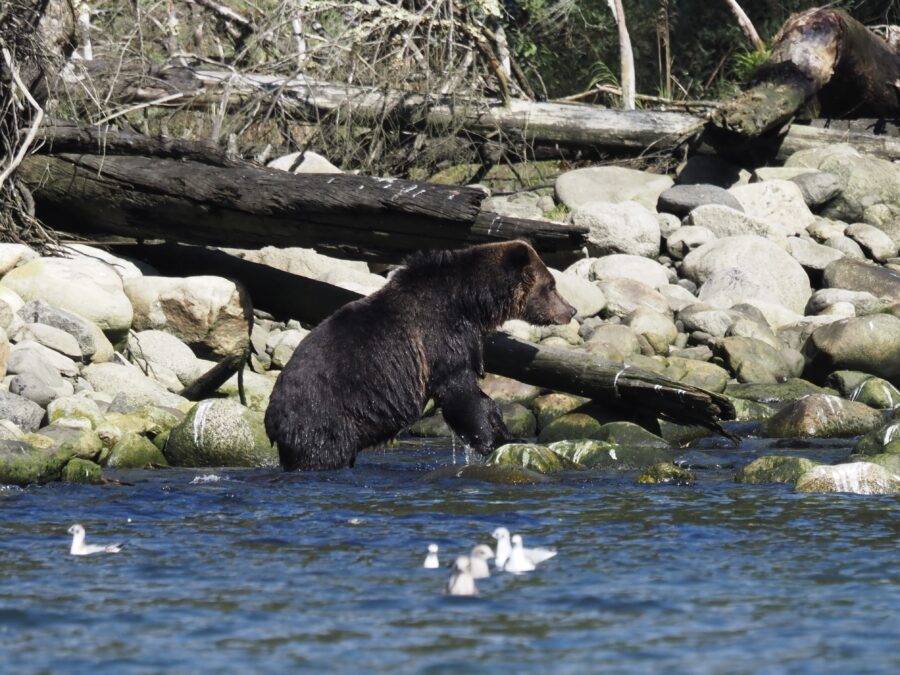
We are now heading west through the Gardner Canal to Europa Bay. This is another endeavour to locate the elusive bear. As we approach the shoreline we spot a grizzly bear fishing in the creek. Hoorah! There is great excitement and our only problem is finding somewhere to disembark. The water is shallow, grasses line the shore and mask the water depth.

We are still in the tender, feel safe and are afforded a great view. The light is just perfect and a huge grizzly goes about his business, not giving us a second glance.

There is lots of bird life here too. Cute harlequin ducks…

…and tiers of gulls…

After several abortive attempts we make it onto terra firma and, staying close together, approach the bear.

The bear makes his way upstream and out of our view. We walk into the forest and settle down on the river bank upstream from the bear… and wait. It is not exactly comfortable and those annoying mosquitos and black flies engulf us. I have at least found somewhere half comfortable to sit amongst some mossy tree roots. A lot of the group have to stand.

Time ticks by and then… across the creek… a black body presents itself. Unfortunately, because it has emerged directly opposite us, it can see us only too clearly. It is spooked and disappears back into the dense undergrowth just as speedily as it had appeared. We sit for an hour or so hoping he will return but to no avail. Nevertheless, I have some great shots, so am more than happy.

Cascadia Adventure Begins

We while away the day at Kitimat Lodge, drinking tea and eating up surplus chocolate bars. The weather is fair so we sit out on the terrace until our taxi arrives to take us on the 15 minute journey to MK Bay Marina. Here we will board our home for the next week – Cascadia.

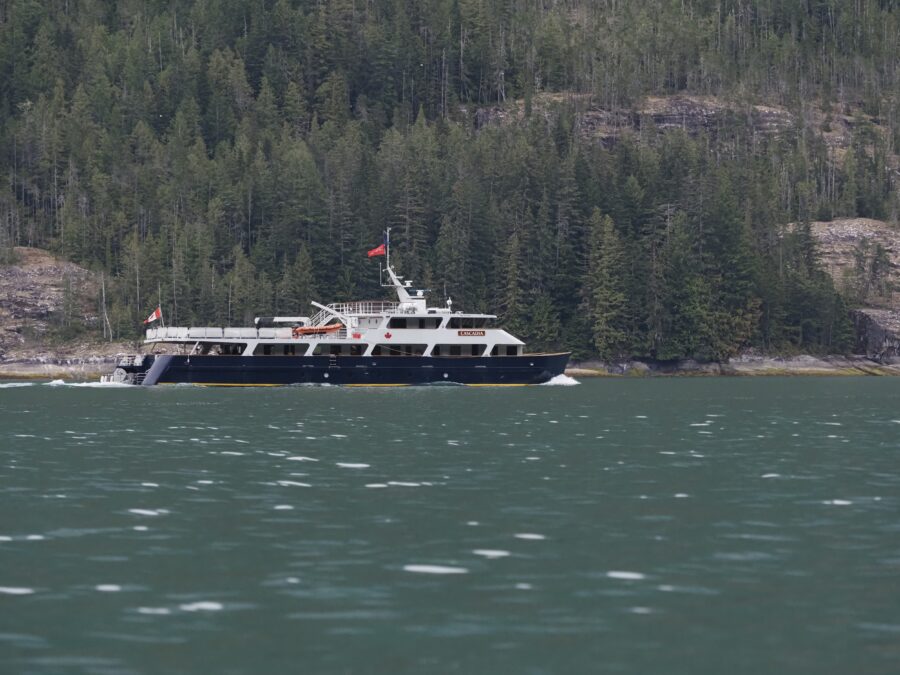
She has a crew of 10 and there are 22 passengers in 12 cabins. We embark at 17.00 and our expedition leader, Phil, takes our photos. This is for ease of remembering who everyone is. Crib sheets are posted on the wall. What a great idea.

Phil shows us to our cabin – Salt Spring – which is larger and more comfortable than I had imagined and with a really good shower.

Shortly after embarkation we cast off and head for our first anchorage at Eagle Bay. En route we are given a safety briefing and talk on life aboard and what to expect. Then it is time for dinner. What a treat! The food is truly excellent and so appreciated after the super fried diet last week!

After breakfast we have our first excursion in the tenders to Gilttoyees Inlet. The tenders are brilliant and are like mini-landing craft with a flap at the front that lowers for ease of shore landings. There is a side door that makes boarding from Cascadia dead easy. So much more comfortable and stable than a zodiac.

The scenery is stunning.

We even catch a glimpse of a bald eagle.

We return to the boat for a photography briefing and light lunch, whilst moving to a new location.

The weather has improved and it is turning into a hot afternoon. We head for the Gardner Canal where our next outing is into Kiltuish Inlet in the hope of spotting bears. The tide is fairly low so we have to progress slowly up the creek so we do not run aground.

There are lots of pink salmon so we are hoping bears may appear. We tie up to a tree root and wait. It is very hot and mosquitos bombard us. Gulls rest along the shore and feast on salmon titbits. Disappointingly there is no sign of a bear.

Come morning, we head east and further in to the Gardner Canal. Yesterday’s sunshine has been replaced with grey skies and moody cloud hanging in the valleys.

We have a morning excursion at Rigby Reach, where we view a variety of waterfalls. There has not been much rain recently so their outflow is light. They must be truly spectacular in the spring when they are full of glacial melt water.

We catch a brief glimpse of a pair of otters scooting along the rocky bank. Seals play in the water below the waterfall above.

The weather has now really deteriorated and we don our full wet gear as it is raining heavily. We head into the mouth of the Kitlope River estuary. There we see a replica of the G’psgolox Pole, the original is also there but lies rotting in the forest close by.

The Gʼpsgolox totem pole was a nine-metre-high mortuary pole that was made in 1872 by the Haisla people on the shore of Douglas Channel in British Columbia, Canada. In 1929 it was brought to Sweden and the Museum of Ethnography. In 2006 it was returned to the Haisla people. In 2012 it was allowed to decompose, in accordance with the Haisla tradition for long-serving poles.

Wikipedia

The Gʼpsgolox totem pole is attached with a legend. It is told that, in 1872, a smallpox epidemic infected the people the Haisla Nation (located in the north of what is now called British Columbia), killing the vast majority of inhabitants. The leader of the Eagle Clan of the Haisla tribe, named Chief Gʼpsgolox, lost his whole family due to the epidemic, as well as many of his friends. The legend tells that the bereaved Chief Gʼpsgolox travelled to the forest and attempted to find help there. In the legend, he met with the spirits Tsooda and Zola, who told the chief to go to the edge of a mountain at dawn, where he would see his deceased loved ones and learn to heal those still living. In the legend, this is how Chief Gʼpsgolox complied and gained vital knowledge, learning the nature of the spirits, the Haisla spirit of continuance and transition. In appreciation of the spirits’ help, Chief Gʼpsgolox commissioned a nine-metre-tall totem pole with three figures. The bottom two figures commemorate the deceased and the top figure represents the Tsooda

Wikipedia

Our wet adventure continues but we all put a brave face on it….

The scenery is great but the unrelenting deluge makes it hard to appreciate. We disembark on a large gravel bank and see plenty of footprints of bears, moose, wolves and more. We are told to stick together as there is safety in numbers.

After a long and soggy afternoon I luxuriate in a really hot shower. I was soaked through despite having supposedly waterproof clothing. I shall be complaining to ‘Rab’ when I get home!

As we move to our night anchorage at Chief Mathews Bay, we pass rock wall paintings. I know little about them so shall need to read up when back home.

Page 5 of 36

Powered by WordPress & Theme by Anders Norén