My Wild Travels

Photography and Travel Blog

Changeover at Santa Cruz

An early start today – breakfast at 05.15. Everybody else on the boat is leaving, but first we will all visit the Charles Darwin Research Centre. There is a trail explaining the conservation techniques and showing the different animal species. It was a bit of a whistle-stop tour and really deserved more than the 40 minutes allocated.

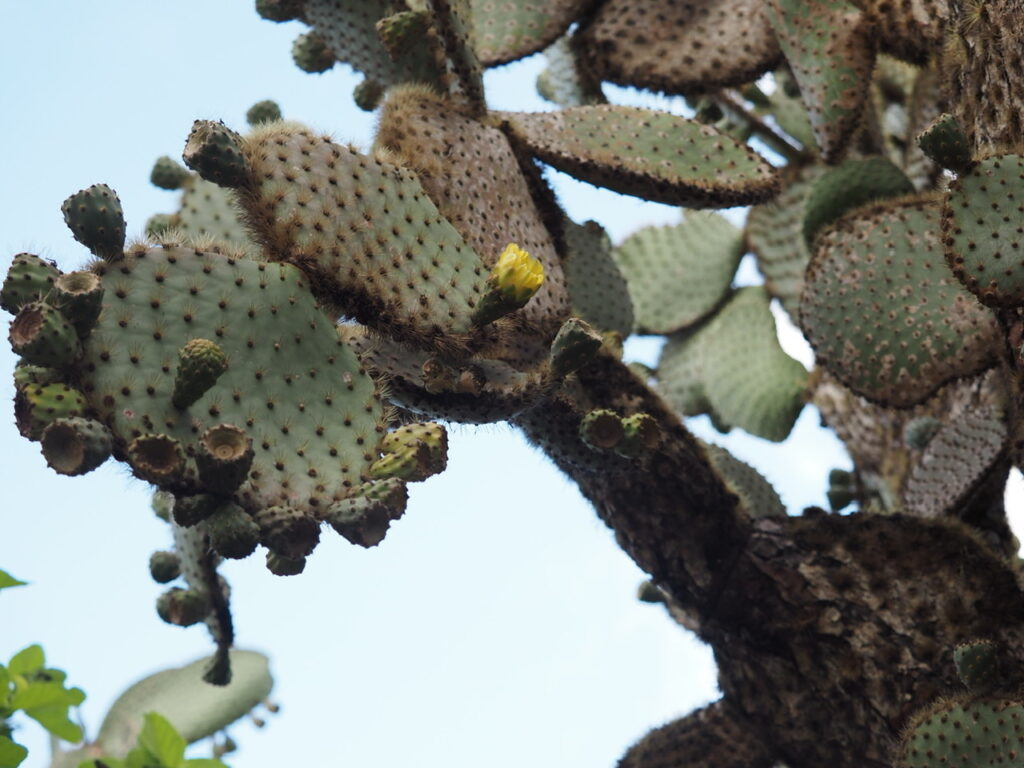
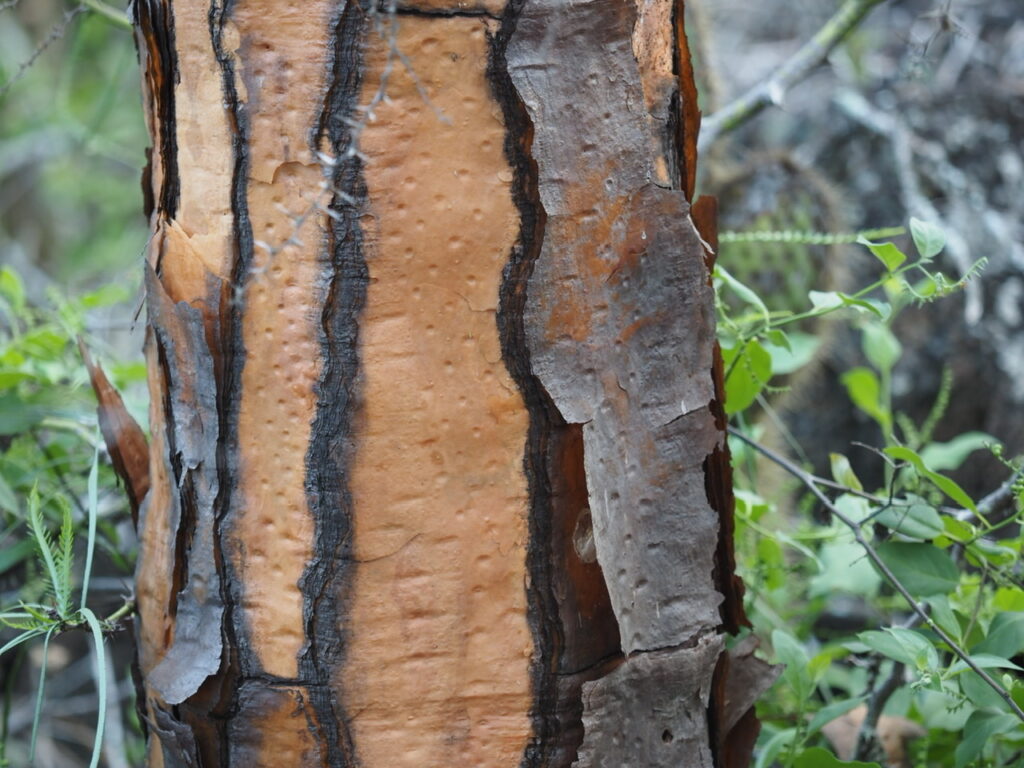
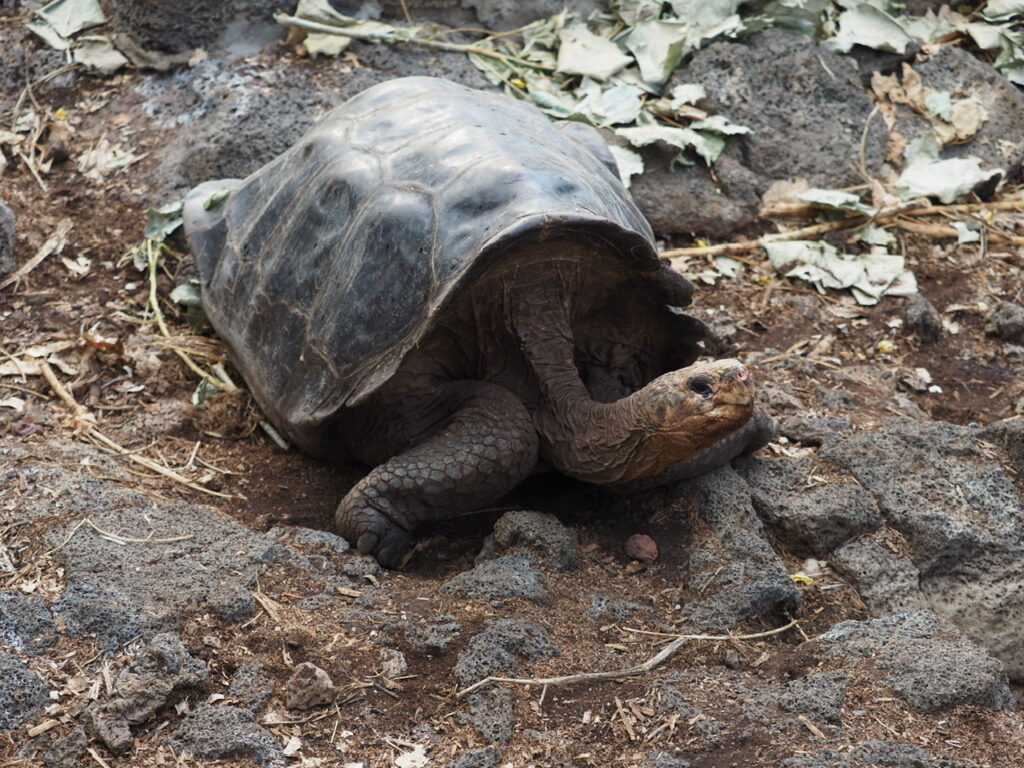
We saw different tortoise species. There were saddle-back tortoises with curved shells and long necks allowing greater reach. The 150 year old cacti were also interesting with particularly striking bark.
Jane & I are back on the boat at 07.30 and planning to have a relaxing morning. I think the crew do not really want us on board and offer us a city tour. City is a bit of an exaggeration. Santa Cruz is nothing more than a small town and very touristy. We decline the offer. It is a little noisy on-board as the crew are cleaning the hull and decks, servicing the engine and checking lifeboats, etcetera

We are due to leave the boat at 1 o’clock to go to the highlands where we will have lunch and see giant tortoises. The village is adjacent to the national park where the tortoises are free to roam wild. People are not allowed to enter this zone but the tortoises are free to wander onto the surrounding land and ranches in their search for food.

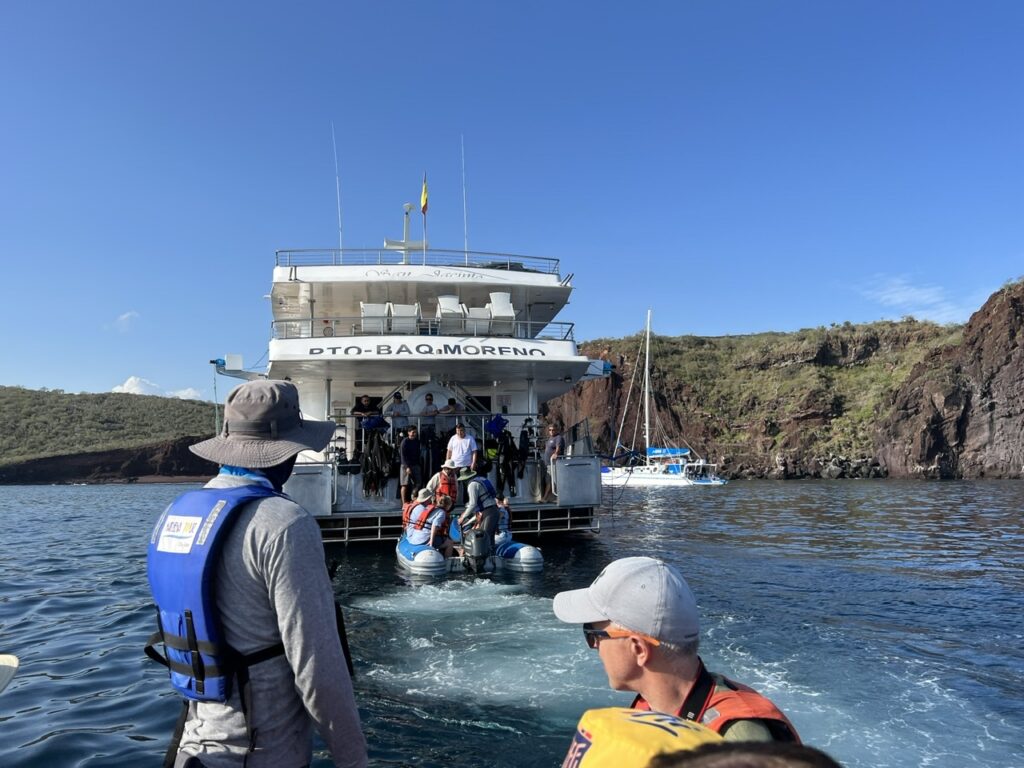
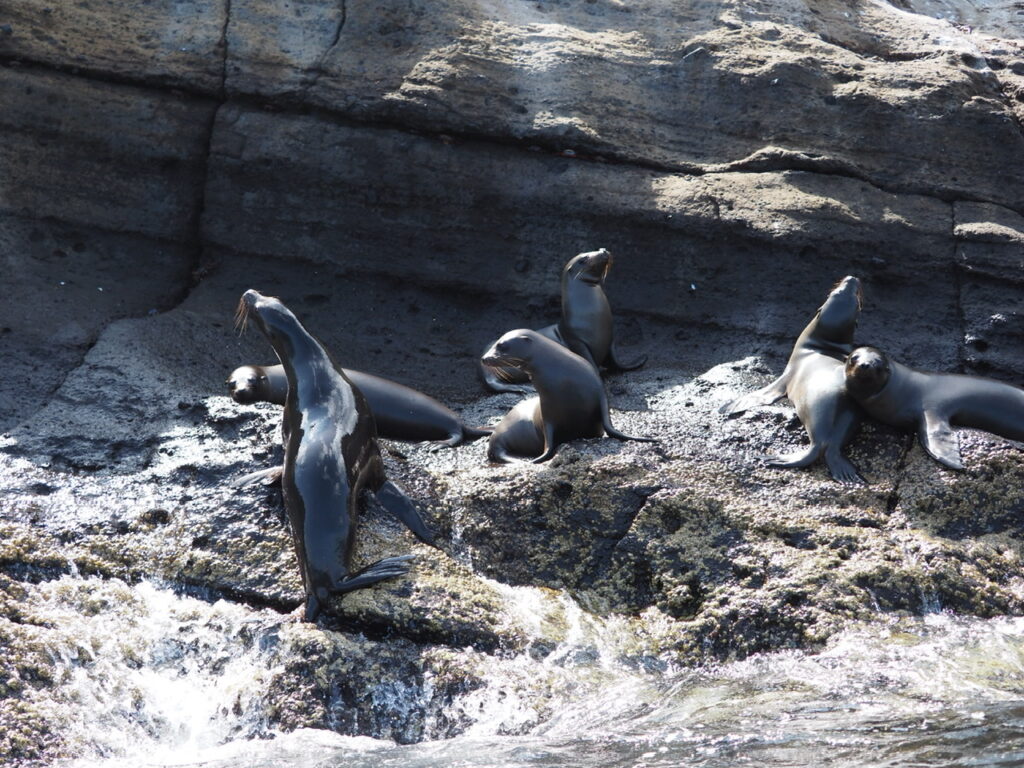
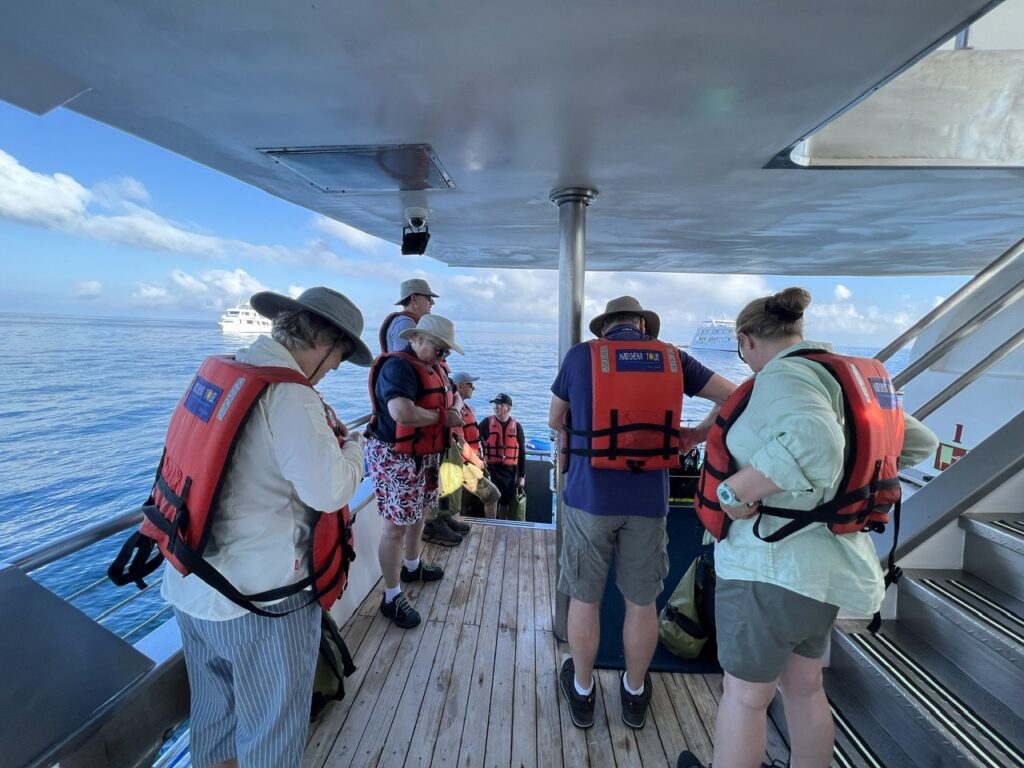
I am just enjoying a beer when we are told the taxi is waiting for us. It is an hour early. Apparently the time has been changed but no-one thought to tell us. No matter. We don sun cream, pickup cameras and are taken ashore. We meet another couple on the dock who will be joining Solaris for the next circuit. Sea lions laze in the shade of the dock, avoiding the heat of the mood-day sun.
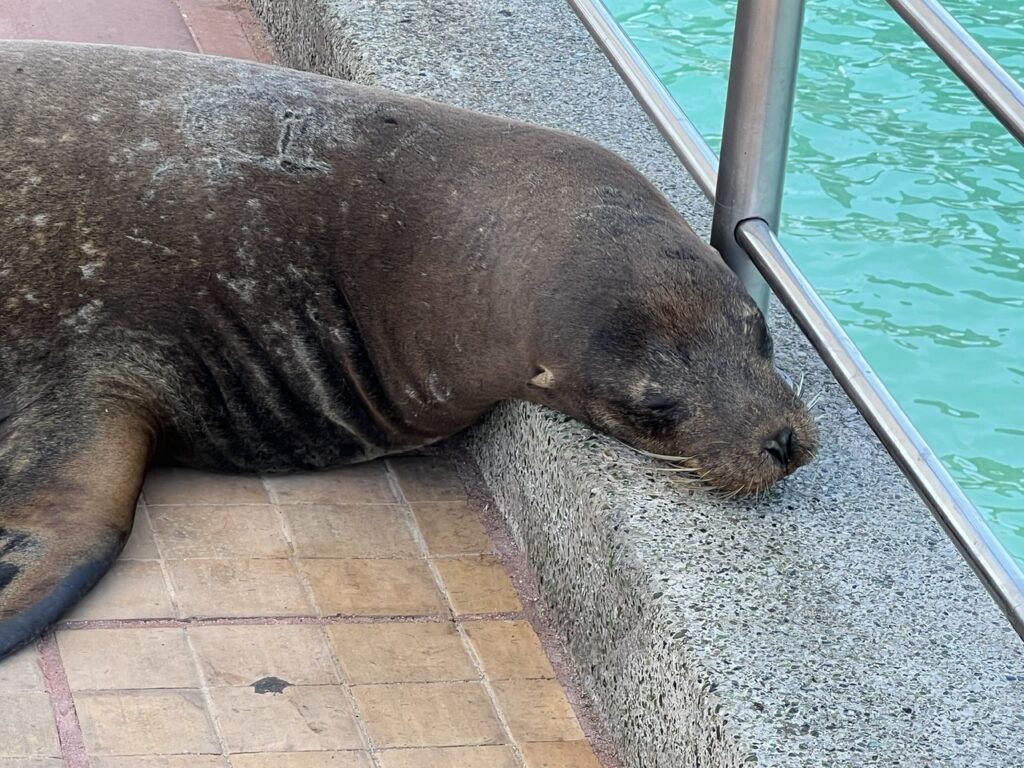
Two taxis await us. The other couple’s one leaves immediately. We sit by the taxi until 12.50. Apparently we are waiting for another guest who does not know about the time change either. Our driver loses patience with waiting and we head off. Annoying to have waited 45 minutes in 35C heat to no avail. I could at least have finished my beer had I known.

It is a 35 minute drive to the ranch. We are going to the highlands. Not that high but in the short drive the countryside changes from arid, virtual desert to a lush green landscape. I am very surprised to see bananas and sugar cane growing. As we near the ranch we pass undulating fields with cattle and the landscape is reminiscent of the volcanic uplands of Costa Rica. Giant tortoises amble along the road.

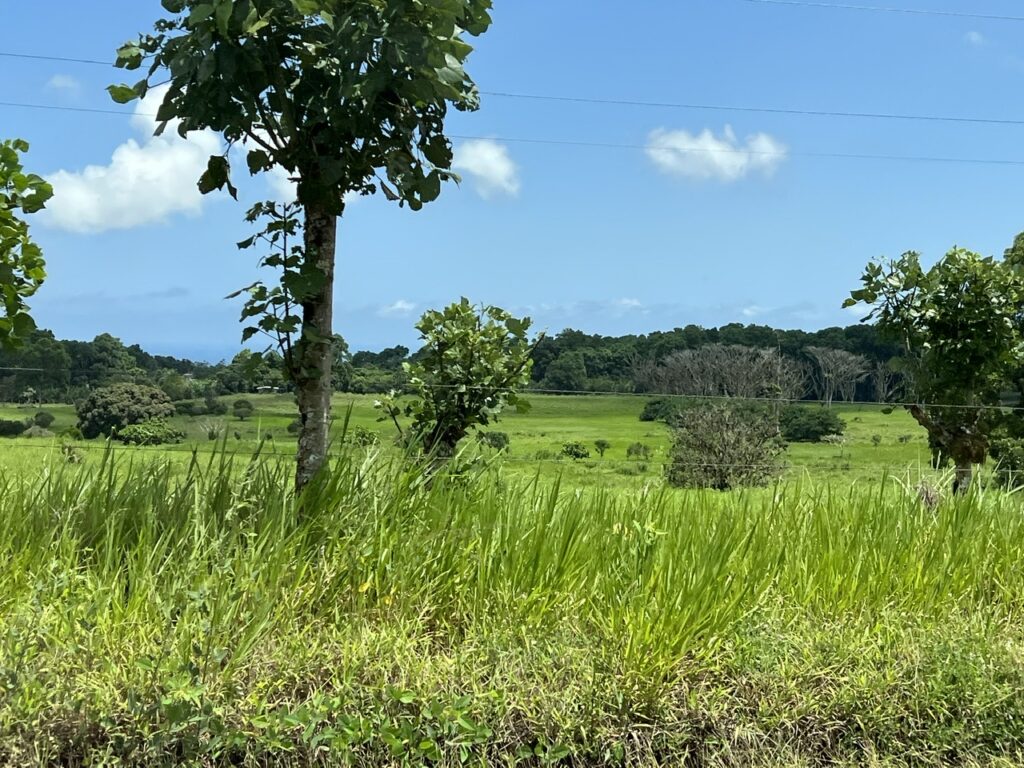
We have lunch and are seated at a table which has all our new fellow crew members. After lunch we are taken for a walk to see the wild giant tortoises. There are quite a few here and it is mating season. The first thing we see is a large male trying to mount a much smaller female. It certainly looks clumsy and hard work for the male who has trouble staying on top. A guide leads the walk and tells us lots about the ranch and also tortoises. 

This area is volcanic and very fertile. At the end of the walk we are taken through lava tunnels. These were made by hot lava flowing fast under a cooling crust. It is very much like being in a cave but disconcerting as in places large chunks of lava have fallen and looking up I can see fissures and cracks.
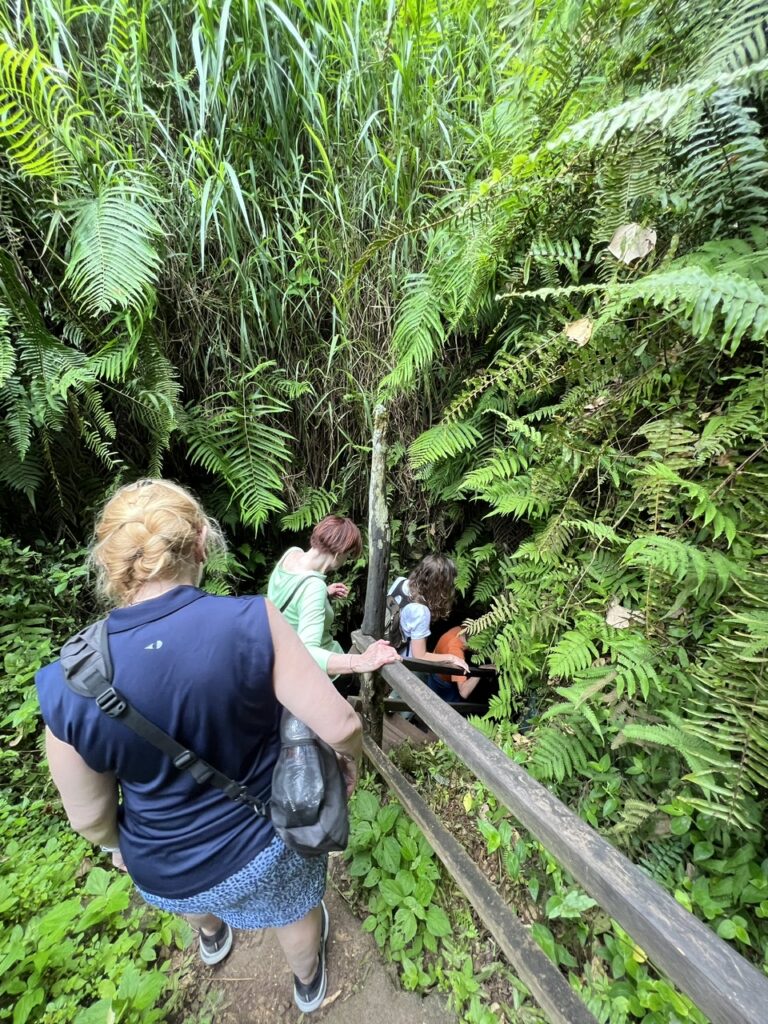
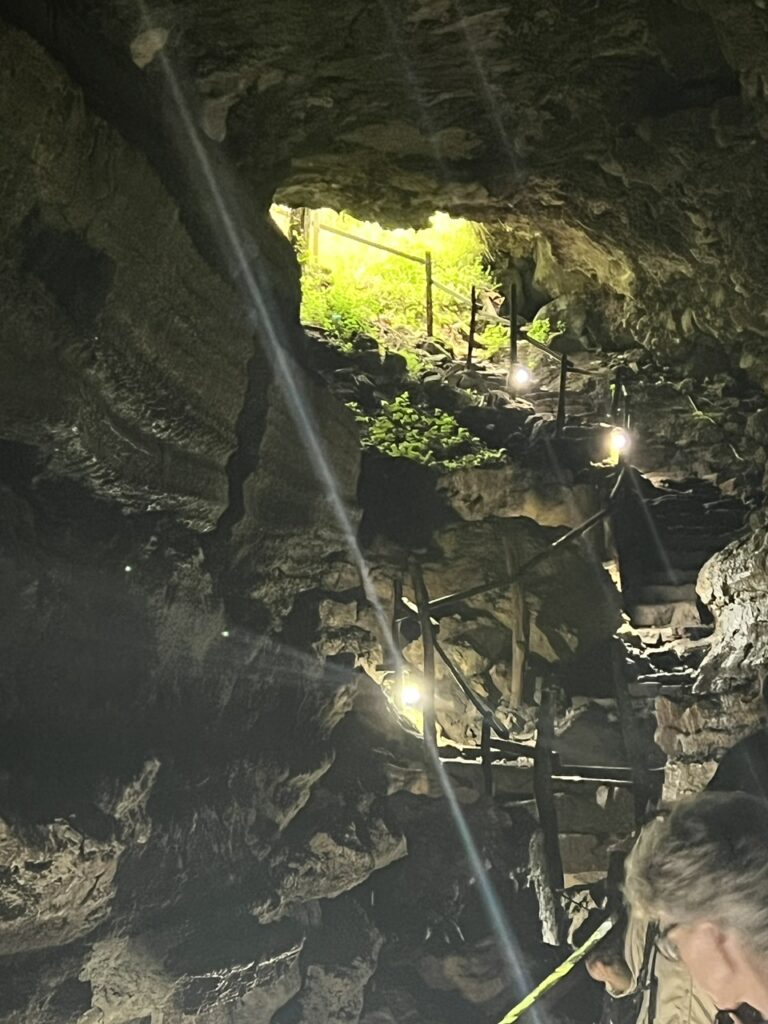
The roof clearly will collapse at some stage and I would prefer to not be under it when that happens. We go through 3 tunnels and at the entrance to one we see a sleeping Galapagos barn owl. A very lucky encounter!

We go back to town on a tour bus and are given an hour to browse before finally re-boarding the boat. I think there has been  some sort of staff issue today. The new arrivals say that their cabins are dirty with bins not emptied. I have no towels in my room. This is different from last week when everything seemed pretty well prepared.

Alexis, our guide has now gone home to Guayaquil and we are introduced to our new guide Fabian. He seems very personable. All the new guests are very sociable and already mixing and introducing themselves which bodes well.

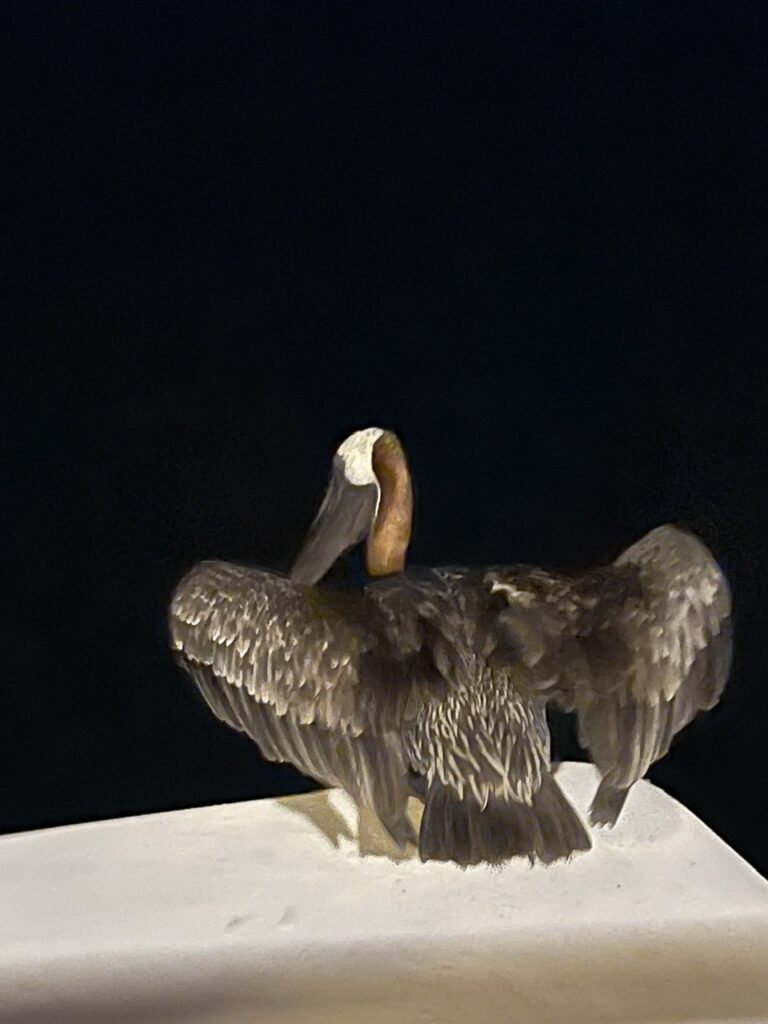
After dinner we spend time on deck and watch a pelican fishing from the back of the boat.
Rabida Island

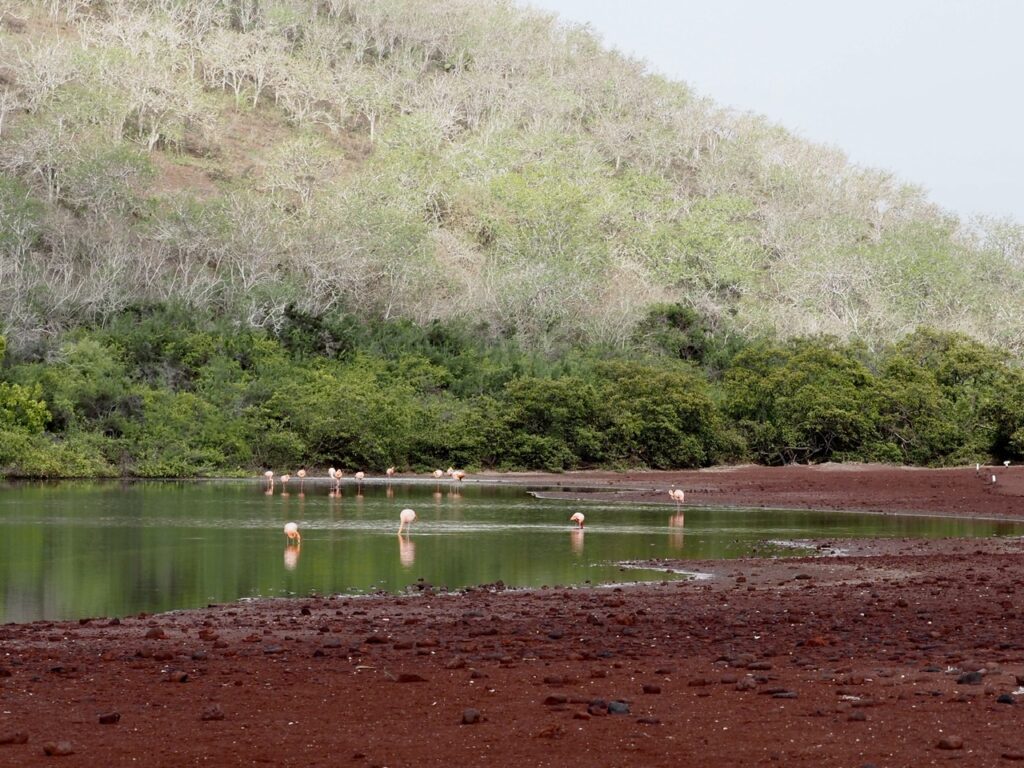
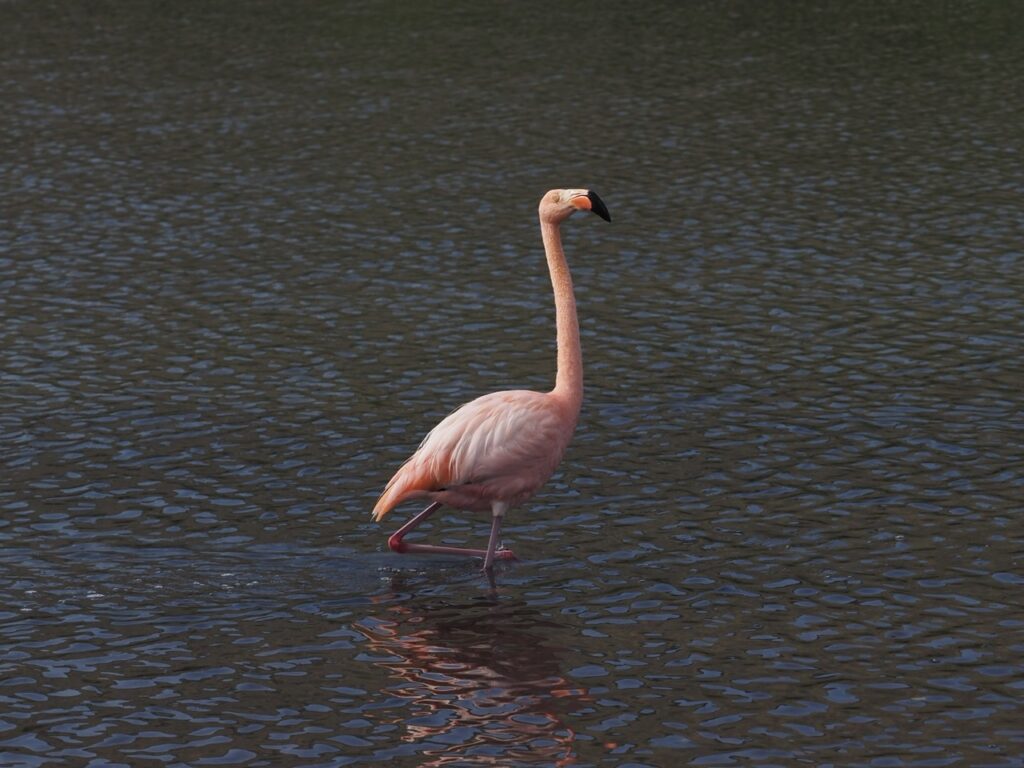
We go ashore on Rabida Island with red beaches and cliffs. There is a large pool and 20+ flamingos wade and sift the water for shrimp. I take what I think are good shots and then discover yet again that the camera end of the lens has fogged. I detach it and let the air dispel the ring of condensation. It only takes a few seconds and the quality of images is significantly improved.

There is a mocking bird in the bushes…

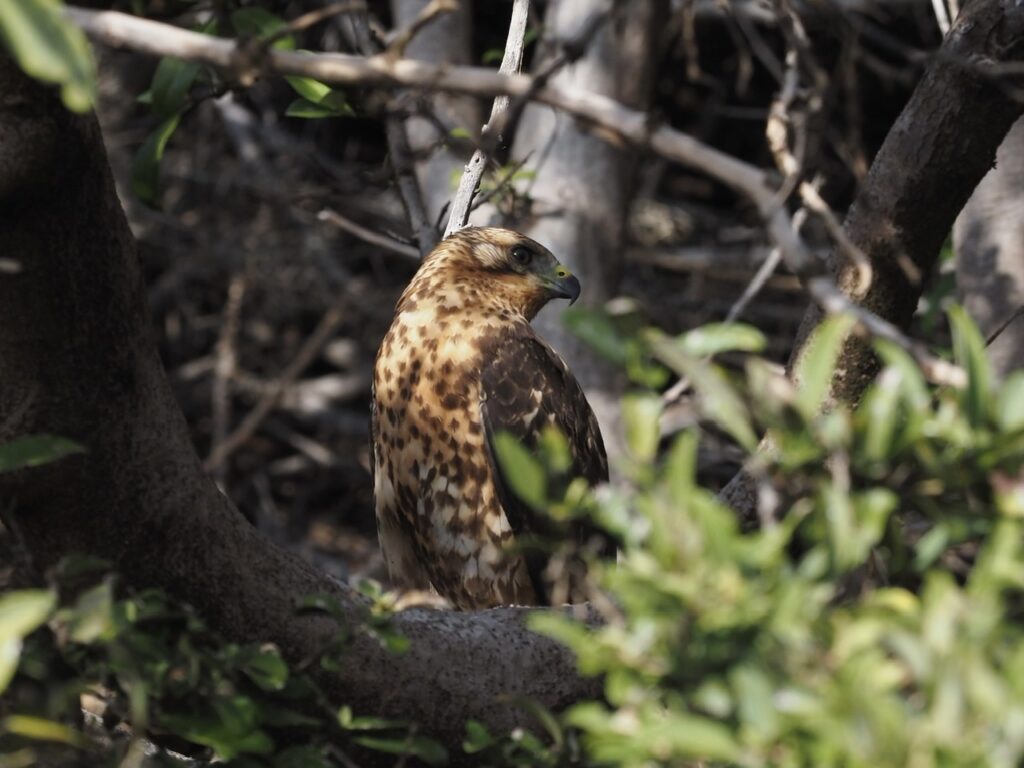
…and a juvenile hawk hiding low in a tree.

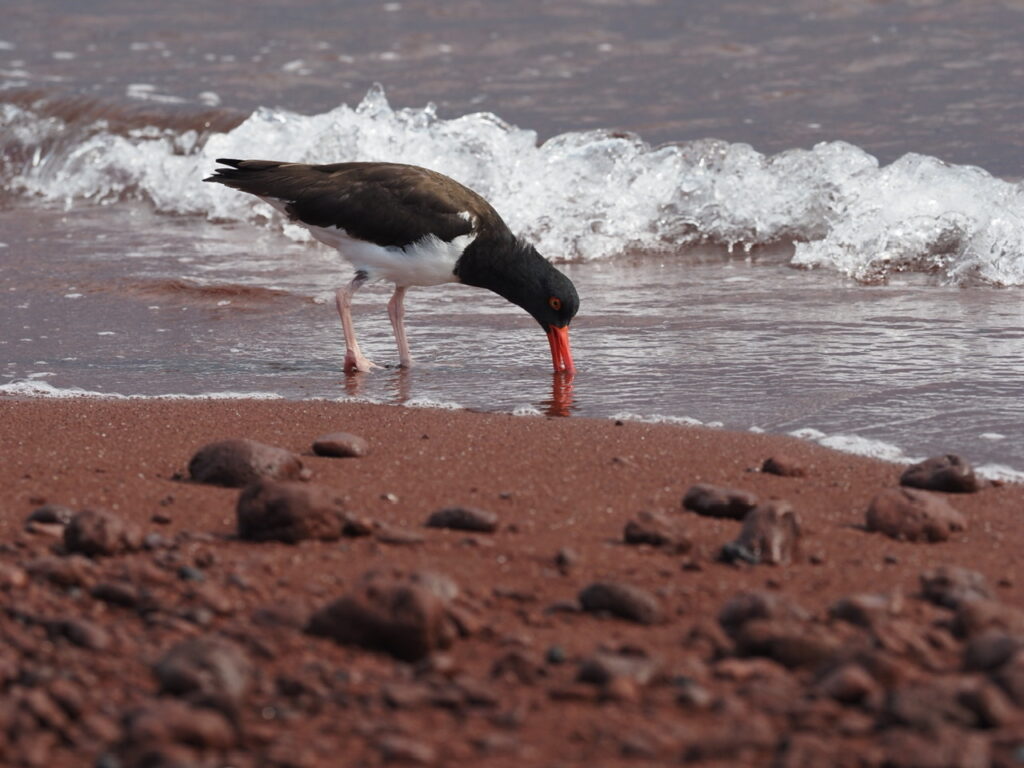
We make our way back along the beach and a pair of oysters catchers are feeding a chick on the shoreline. I sit down and keep still. The chick is curious and so close that I think it will peck at my toes. Too close for pictures at this stage!

We then snorkel along the rocks at the end of the bay. The fish life is good but this is not the best snorkel here and the current on the swim back was quite strong. On entry a cloud of comb jelly fish hang below the surface. They are benign and do not sting.

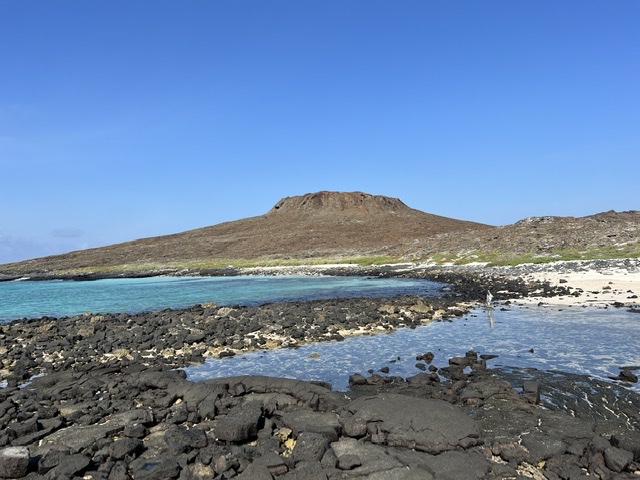
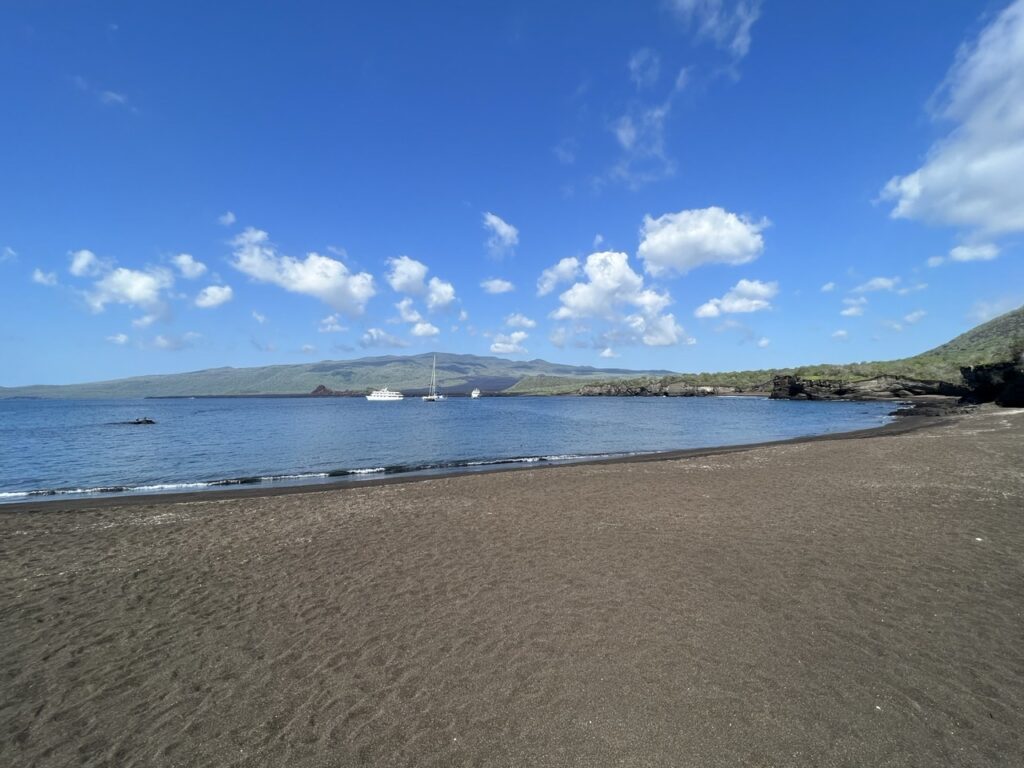
We then make passage to Chinese Hat. This is an island created as a vent from the main volcano and its shape is indeed very much like a paddy planter’s hat.

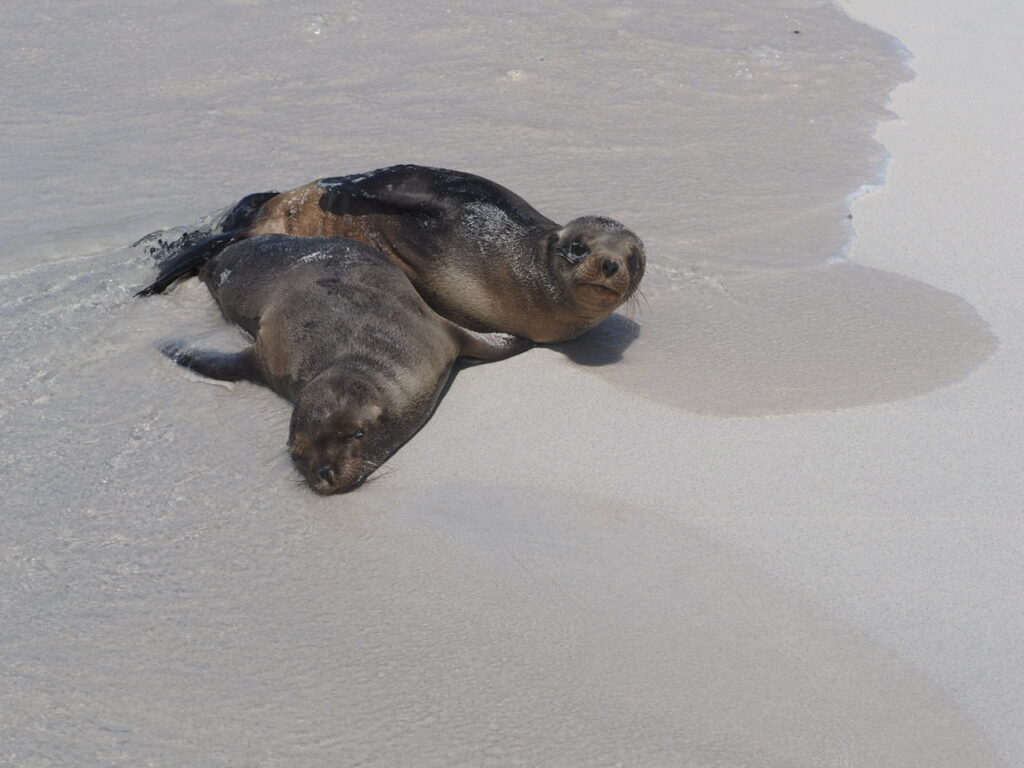
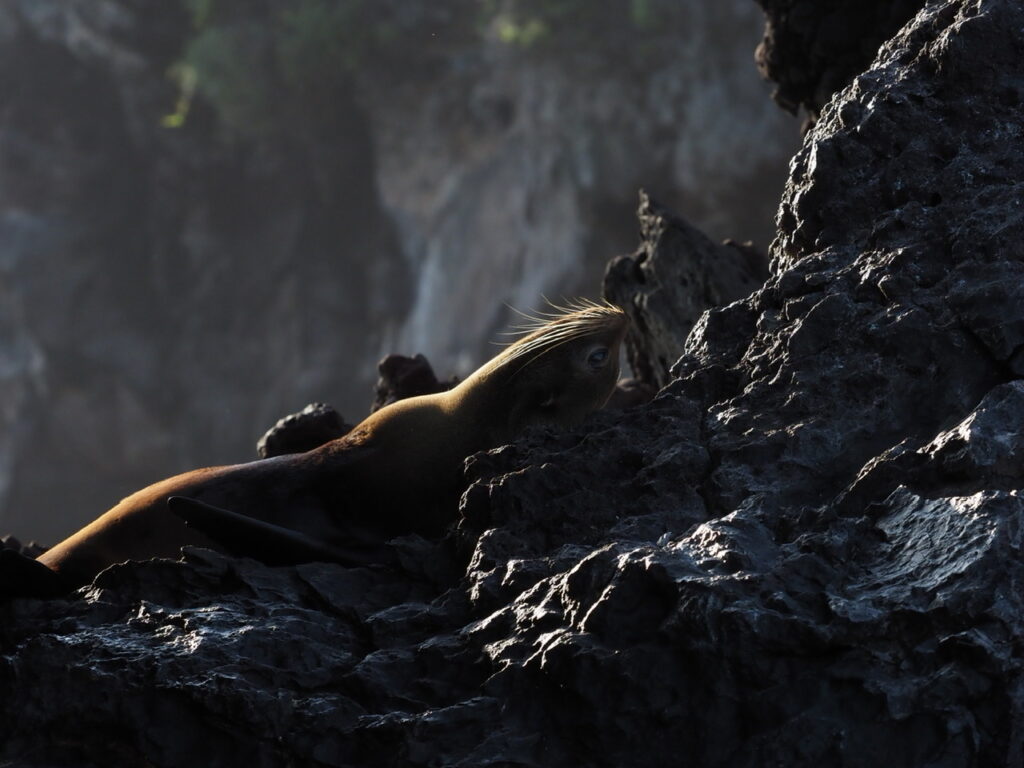
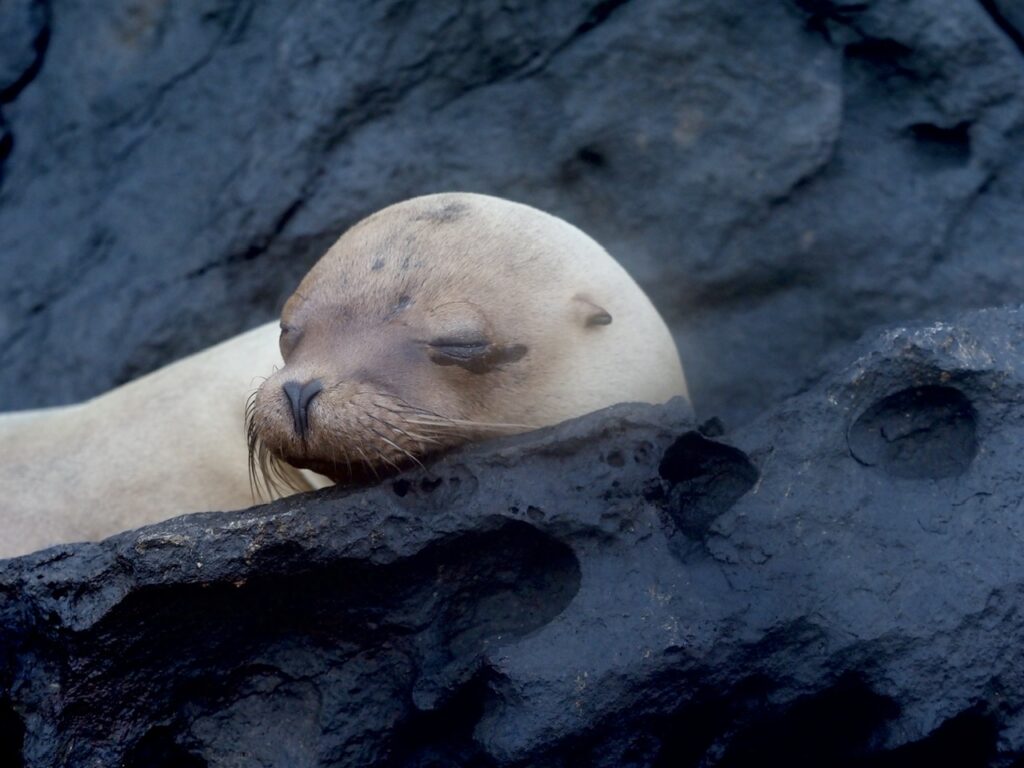
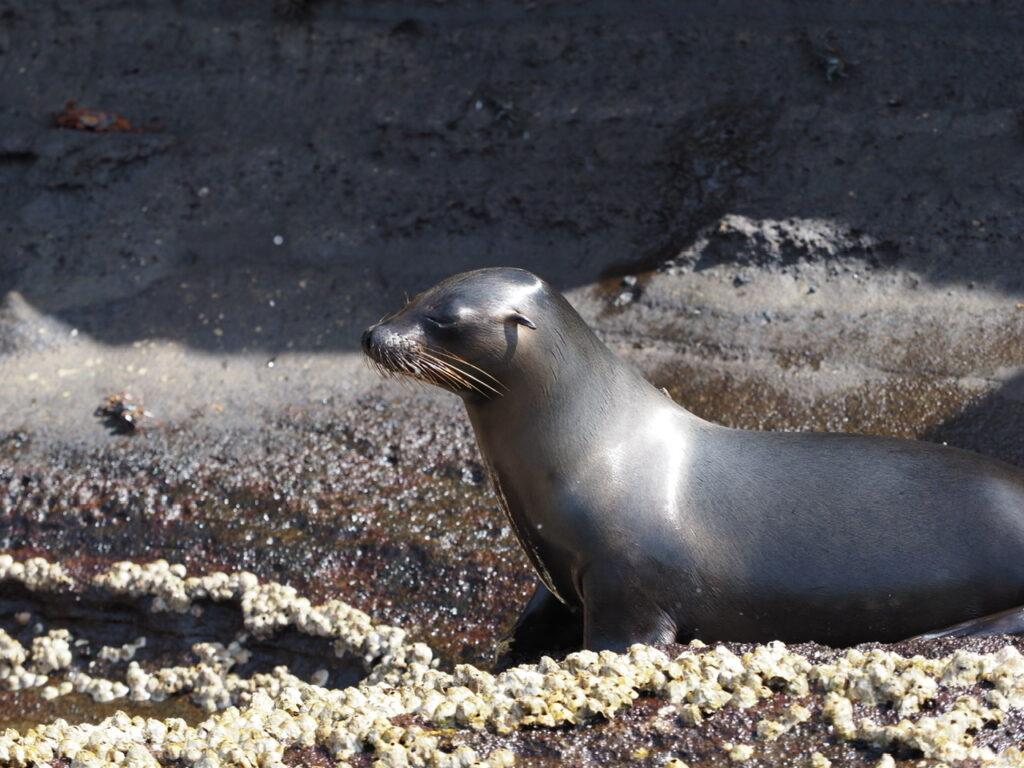
We make a wet landing on white coral sand. Two sea lions laze and are occasionally cooled by the lapping waves.

A third sea lion comes ashore. It is inquisitive and makes its way towards us. It takes a liking to me. I am crouched down and think I will have the most amazing shots as it approaches within 3 feet of me. But guess what? The flipping lens has fogged up again and I dare not move to clear it. Frustrating. This is not to say that I did not take some decent shots however. Just not as incredible as they could have been.

We walk along the shore. It is a truly beautiful place. There is loads of coral washed up on top of the lava.

Up until the late 1980s there was a thriving coral reef here. However there was an extreme El Niño then and the coral has died. I did see tiny corals regrowing in one or two spots, which is encouraging, but there is a long way to go.

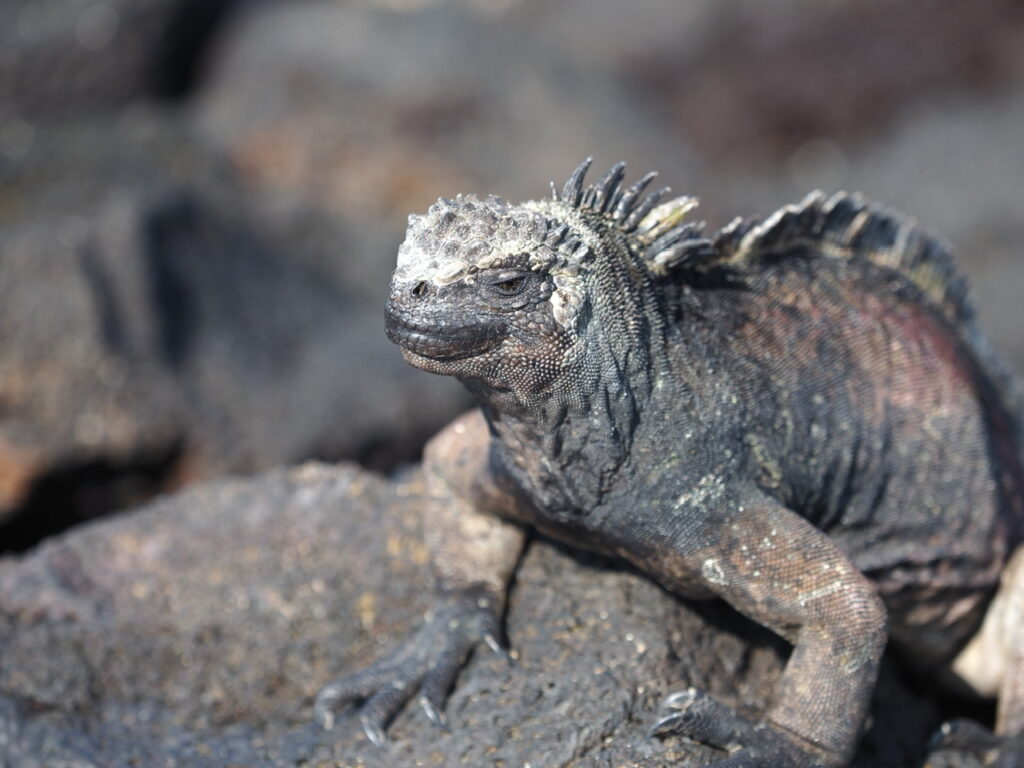
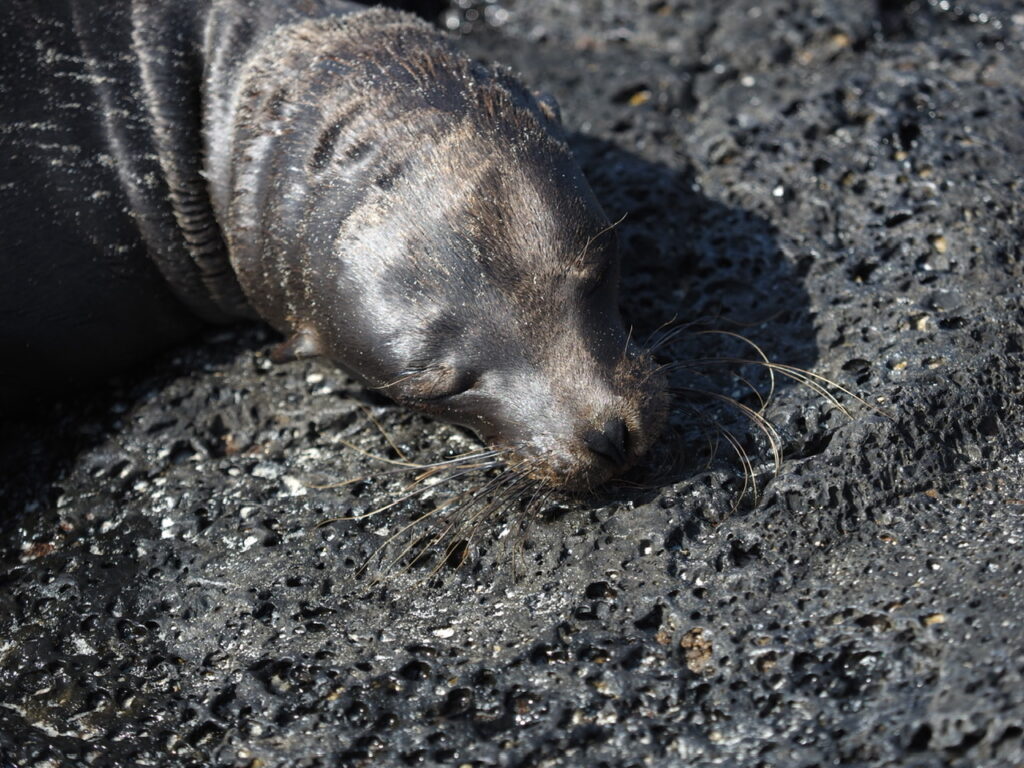
We walk across the jet black eroded lava and watch a heron stalking fish in a rock pool and a marine iguana sunning himself on the rocks next to a sleeping sea lion.

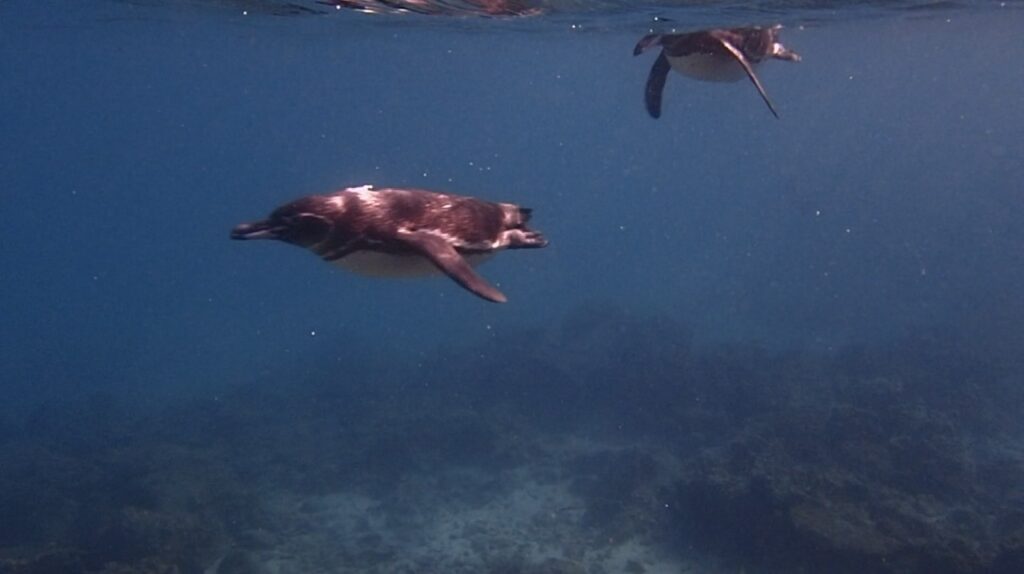
The snorkelling here was incredible. There was little current and good visibility. Four penguins pretty much swim into me….

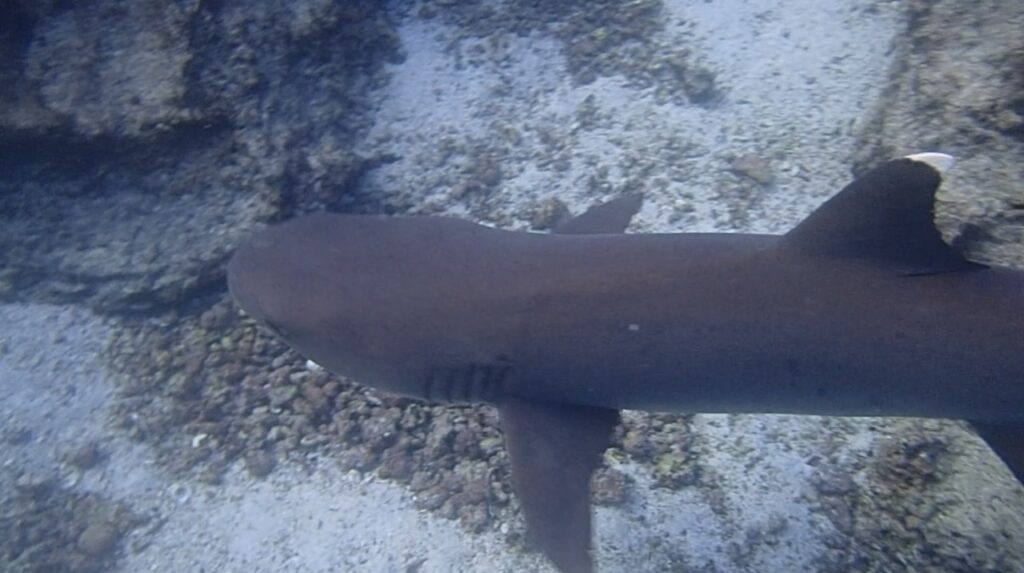
I see a large white tip shark…..

…but abort following him because an eagle ray has swum below me going in the opposite direction.

I then encounter the penguins again….

….and find four huge white tip sharks sleeping under a ledge. Just wonderful. It is hard to describe just how special these encounters are. I have snorkelled for years but never experienced anything like this.

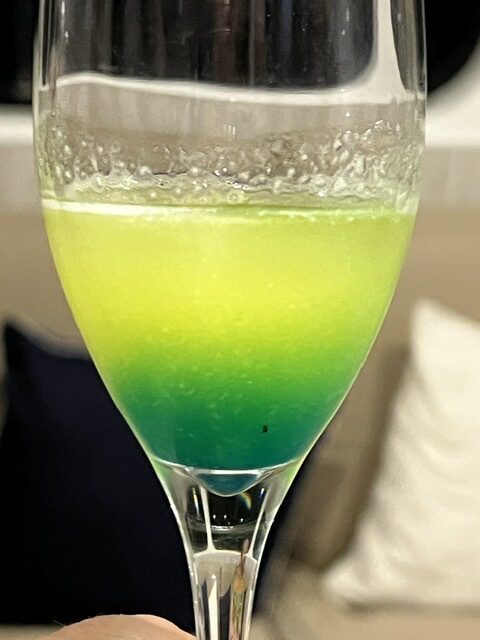
This is the last night for everybody else on the boat and they will leave tomorrow. We are lucky and have two more circuits to make of the North and South islands and I am sure these will be just as varied and amazing as the Western Circuit. The crew all line up for a farewell drink. Kerli, the barmaid, has made a revolting green concoction.

The saving grace is that she is very economical with the quantity in each glass, so it’s easy to down it in one ghastly gulp. This is penny pinching on a ridiculous scale. The welcome drink was no better and also served as a minuscule measure. It sends a really negative message. Why on earth the crew cannot buy a couple of bottles of cava and give us all a full glass of something drinkable is beyond me. Likewise running out of white wine is not OK. This was not a cheap cruise by any means.

James Island

It is April Fool’s Day and there are no jokes apart from the fact that I cannot unlock my door. I open the window and call out. Jane hears me and says “Are you alright.” I say “No. I can’t get out of my room.” She goes to fetch someone. In the meantime, I fiddle with the lock, which I cannot turn at all. I decide maybe if I hold a bath towel around it I can get more leverage and after a few minutes of fiddling I managed to unlock the door.

We are anchored in Buccaneer Cove on James Island, also known as Santiago. There are towering cliffs with impressive rock strata. After breakfast we have a two hour panga trip along the coast.

Photography is difficult. The boat bobs around in the swell, is constantly being turned so that no matter which way you turn your body, you have to move again three seconds later. I am at the front which should help visibility, but everything we see is either behind me or I am shooting into the sun. As it happens, I am pleasantly surprised that I have managed to at least record some of what we have seen.

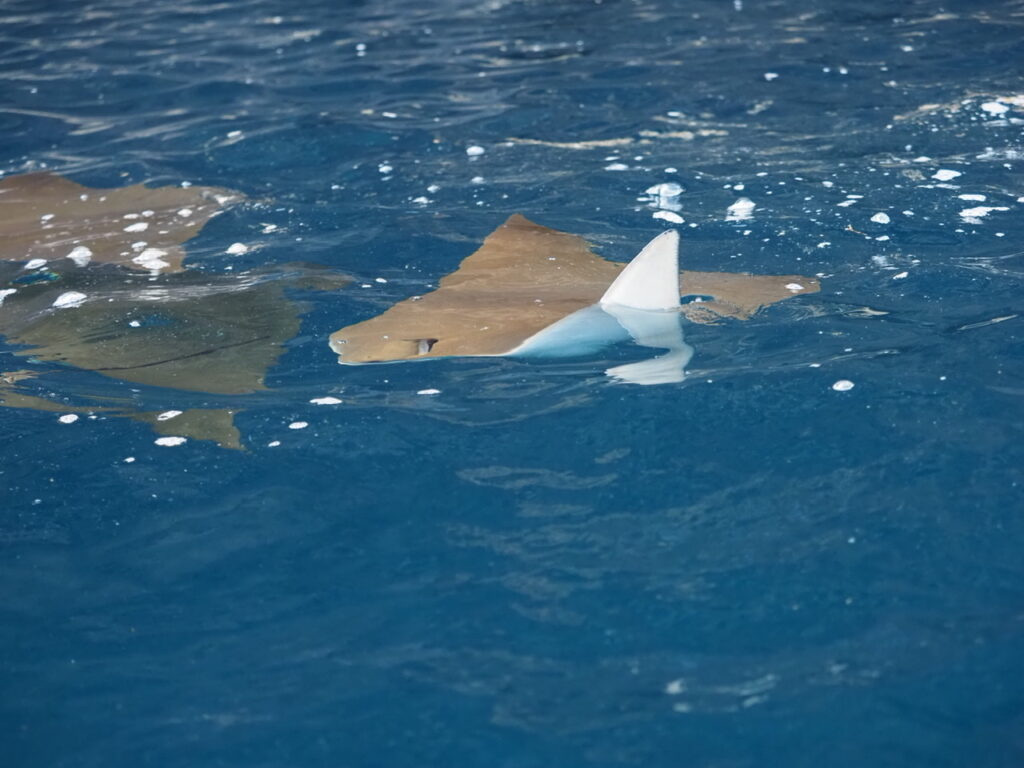
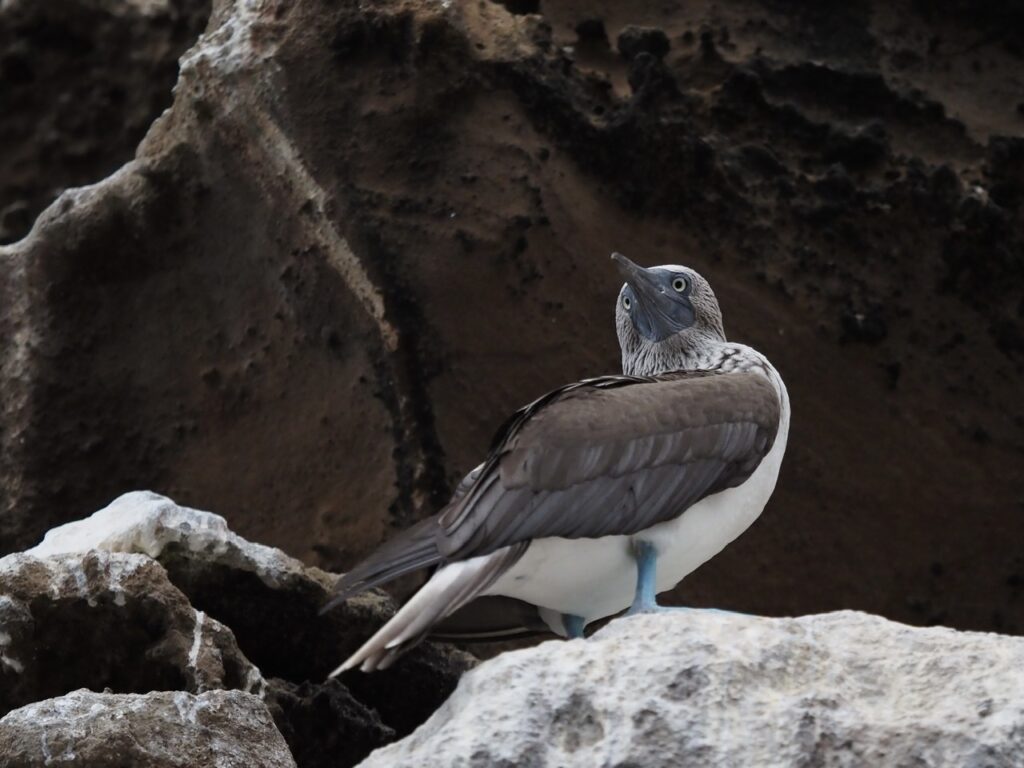
We see blue-footed boobies, nazca boobies, swallow-tailed gulls, pelicans, lava herons, noddys and sea lions. Then we see something we have never seen before – twenty or so golden rays gliding along beneath the surface. The water is crystal clear and we can see them brilliantly.

In amongst them are a couple of small manta rays. On our way back a manta ray leaps out of the water and somersaults. It is huge but only jumps once so no evidence I am afraid.

We have a quick 20 minute turnaround to go snorkelling. I decide on a wetsuit as it is a deep water snorkel along the rocky coastline so I think the water will be cool and I also will have protection if the swell carries me onto any rocks. Visibility is not particularly good but I do see 3 white tip sharks and am visited fleetingly by two sea lions. As we near the shore, visibility is down to a couple of metres, so we all decide to abort the snorkel.

Before lunch we are shown the kitchen and treated to a cookery demonstration of how to make traditional Galapagos ceviche. This is then our starter for lunch and very delicious. In the meantime the ship changes location and we admire the scenery on route to our next location.

In the afternoon we make a wet landing on Espumilla Beach, James Island. We leave the beach and walk along a dusty track between scrubby trees. Alexis shows us an aromatic tree that the locals use as an insect repellent. It smells of liquorice and when burnt in homes acts as a natural insecticide.

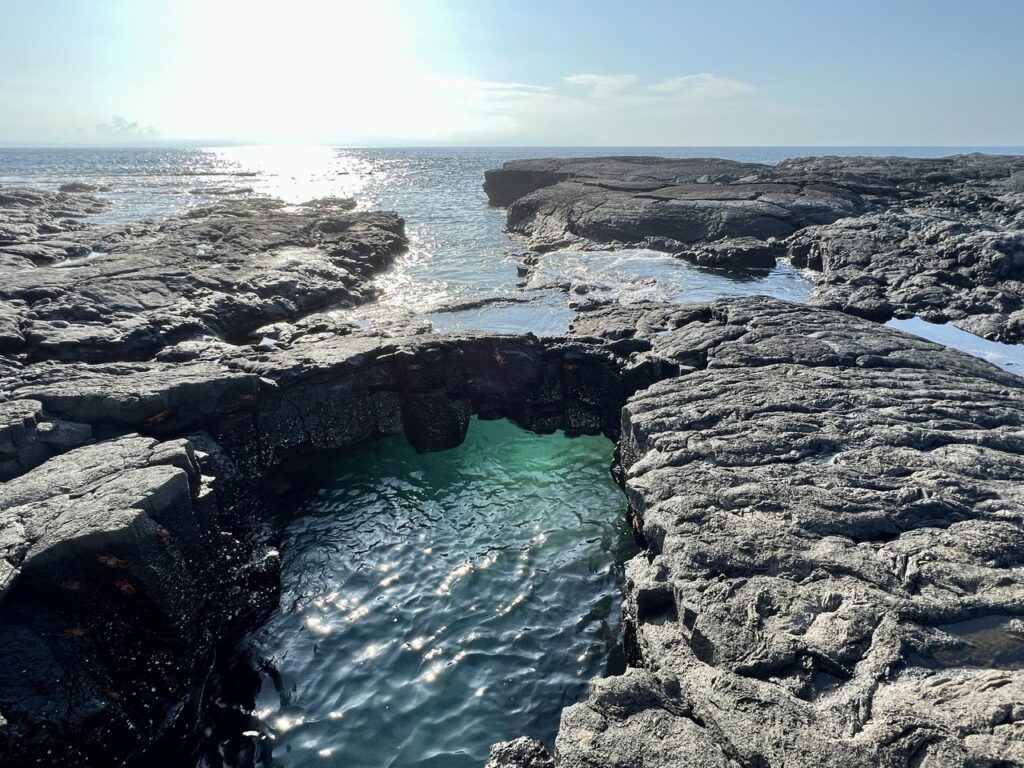
We enjoy a guided walk along the coastline composed of lava flows that have eroded in places forming arches and blowholes.

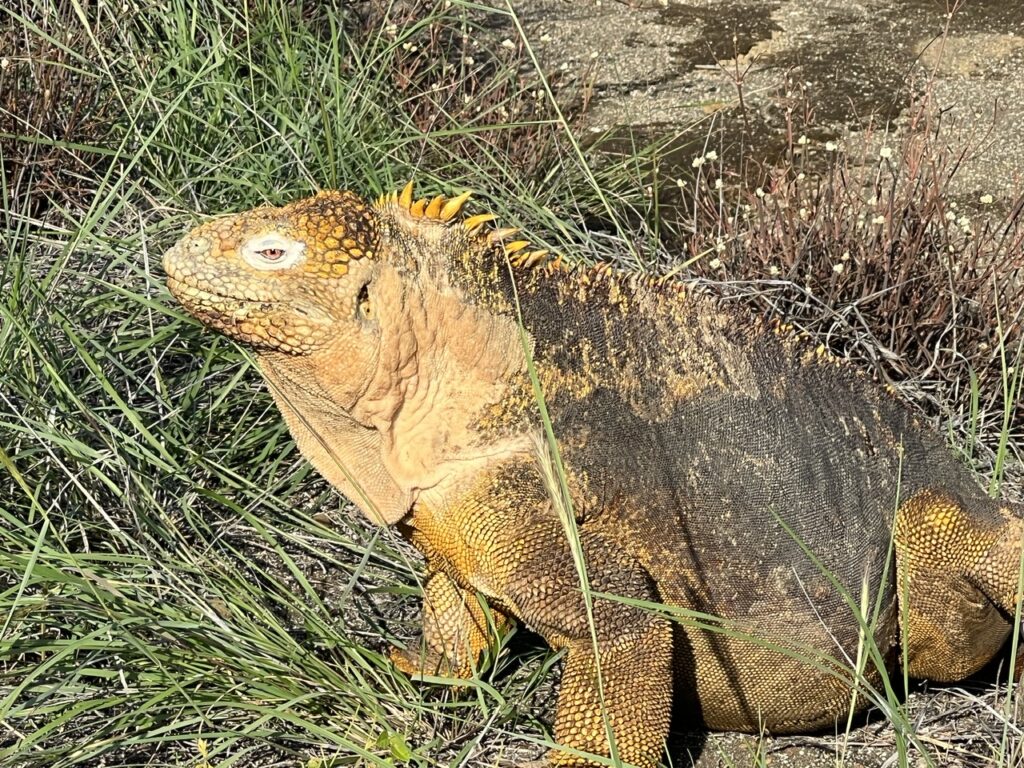
The views are just stunning. Finches and warblers call from the trees and we see 3 land iguanas. They are big – much bigger than the marine iguanas. For some reason best known to myself, I decide to not bring my camera on the walk. I am annoyed as there is lots to see and I have to make do with the iPhone. In fairness it does a pretty good job.

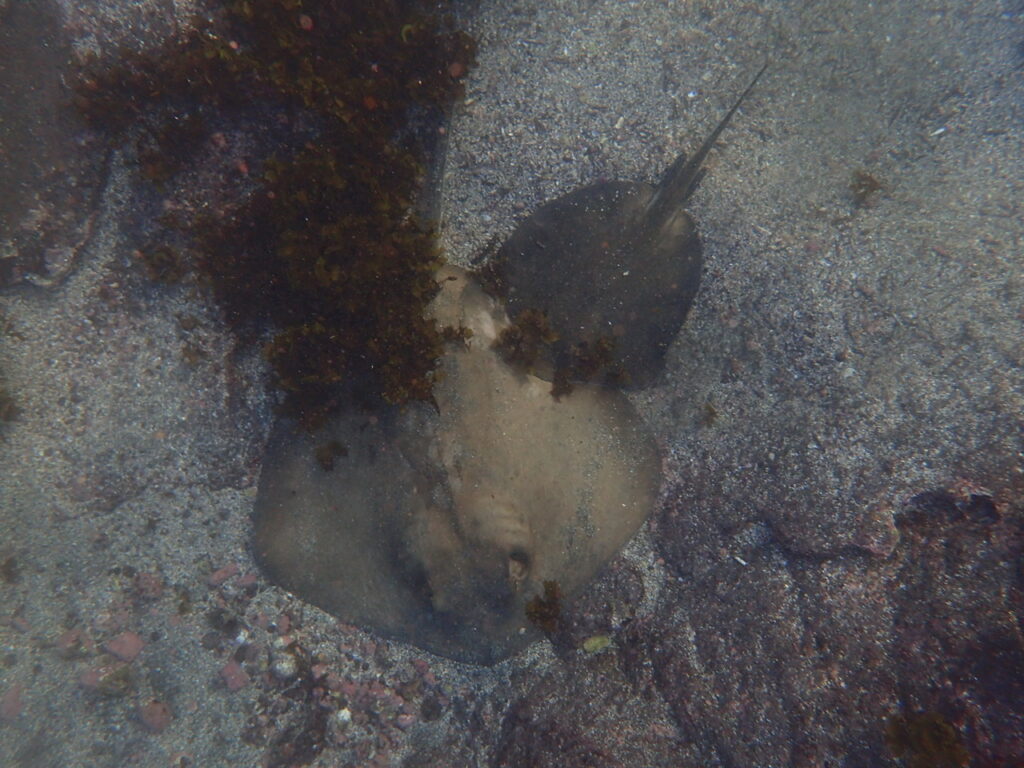
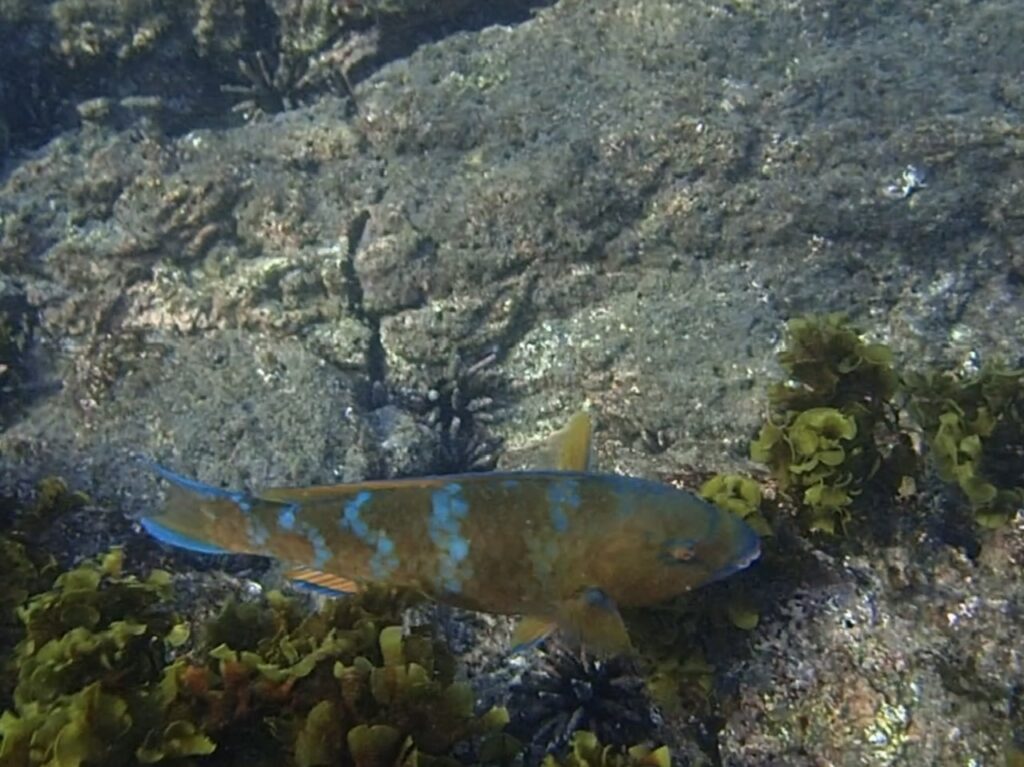
After the walk we snorkel off the beach. It is very hot – has to be close on 40C and a swim is exceedingly appealing. The water feels cool, but it really is not. I do not have high expectations for the swim but I could not be more wrong. I have never seen so many fish in my life. Rocky outcrops are completely covered in shoals of fish and when you look at the shoals, smaller fish are within them. There are huge parrotfish of varying colours, beautiful angelfish, a large potato grouper and loads of fish that I need to look up. I also spot an eagle ray swimming below me and a huge stingray rests on the sand with a smaller one on top of it. As if this wasn’t enough somebody spots a shark and as I swim to find it, a sea lion swooshes past me. It’s just astonishing. Life in the seas here is so abundant. I have never in my life experienced anything like it.

Dinner is good with tomato soup, red snapper and some yummy moist vanilla cake with an oozy sauce.

Fernandina

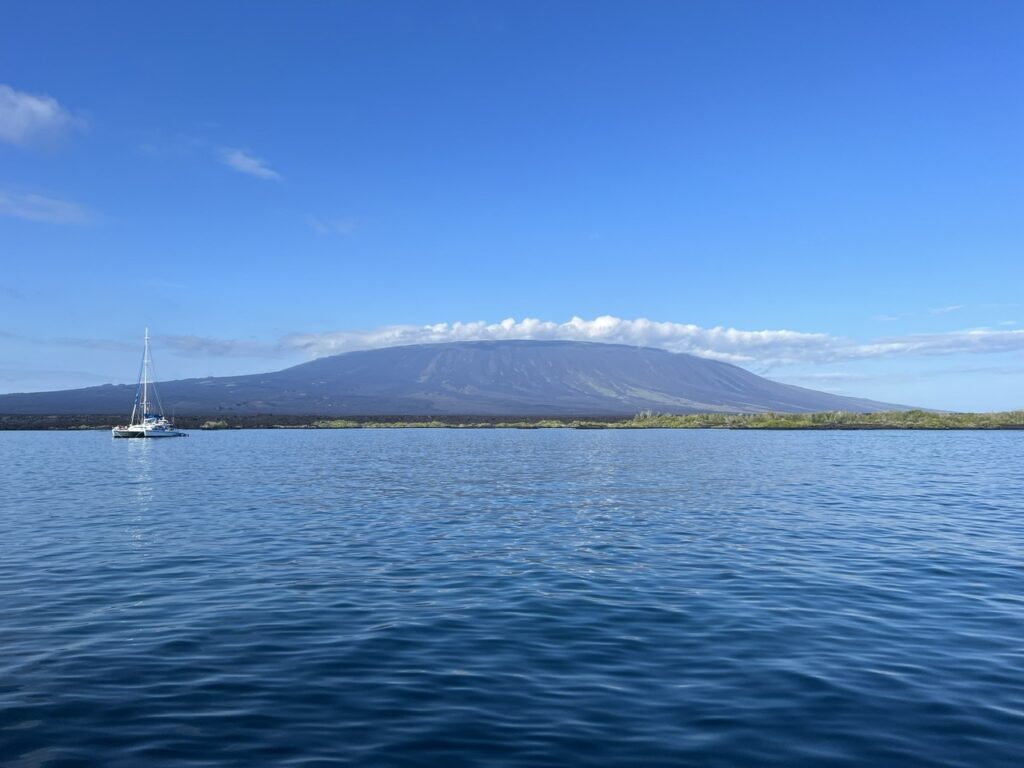
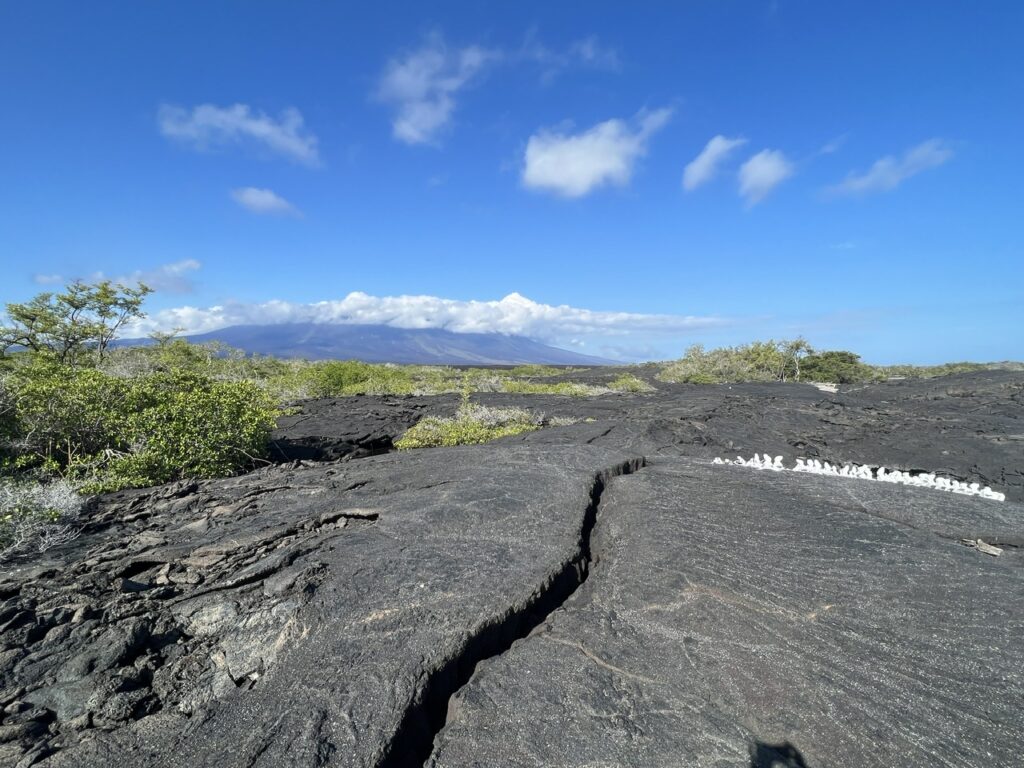
We breakfast at seven and leave in the tender at 8 o’clock to go ashore on Punta Espinoza,  Fernandina Island. This is one of the youngest volcanic islands in the world. Pitch black lava-flows, a dome-shaped summit and green mangroves dominate the landscape here.

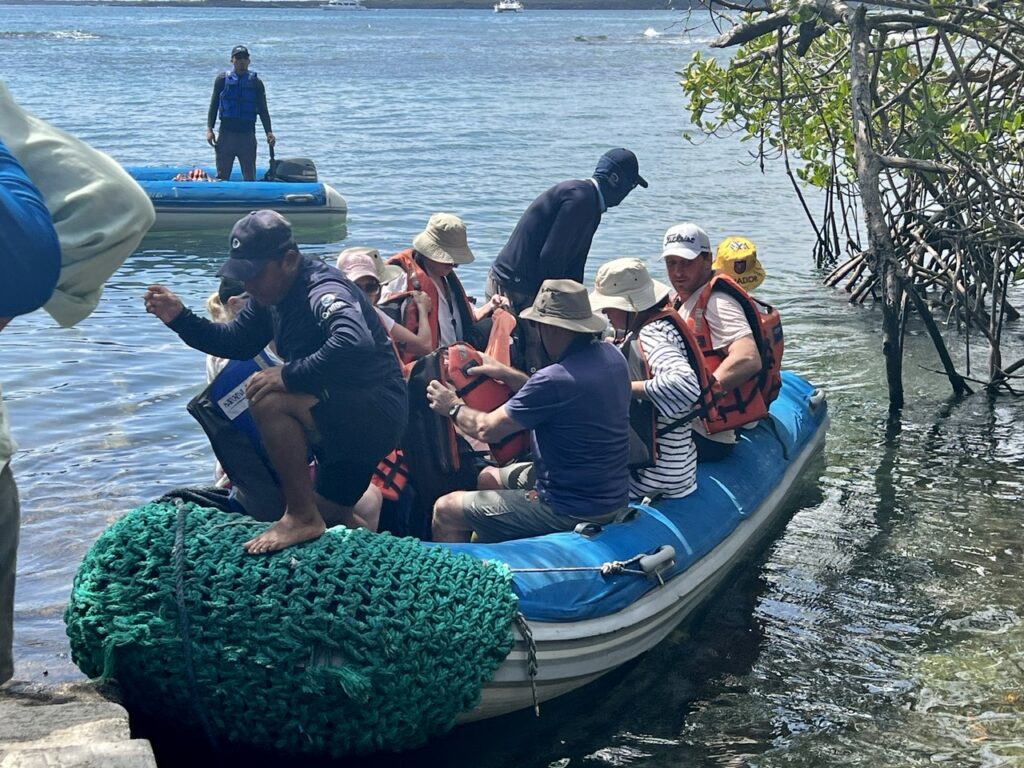
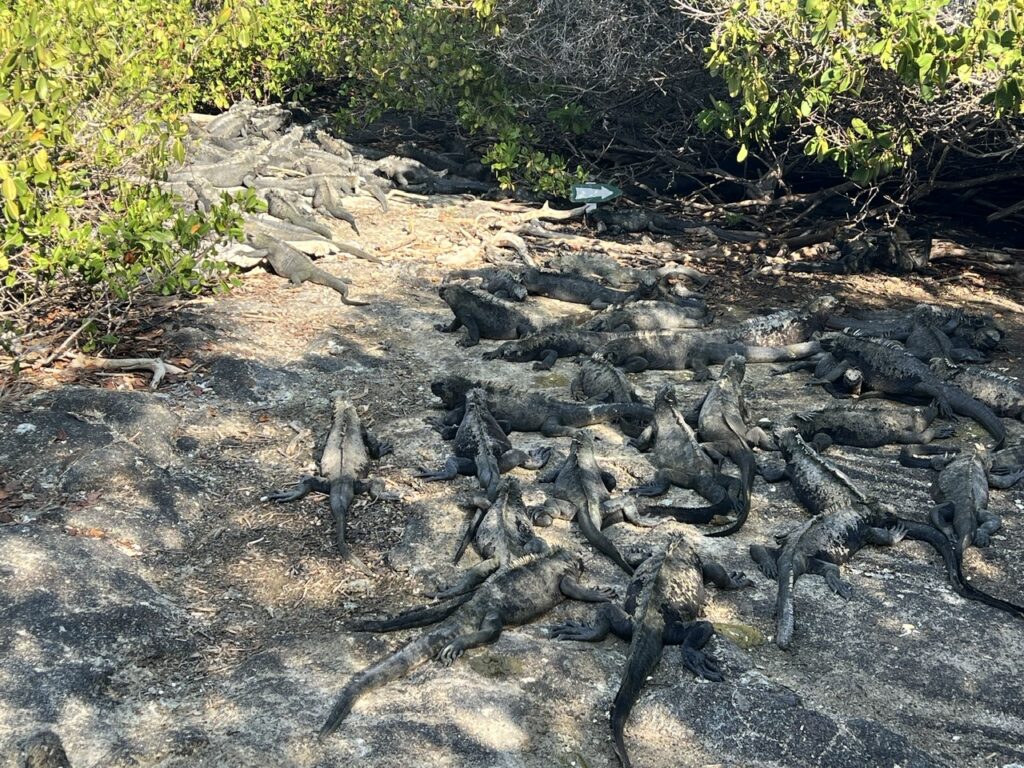
We negotiate the rocky outcrops and motor into the sheltered bay. We step carefully onto the concrete steps which are a little slippery. Hoards of iguanas are sleeping on the path under the trees.

This island has an extremely high marine iguana population and Alexis our guide has told us to watch very carefully where we step. My camera appears to have become very misty. I examine the eyepiece and the end of the lens. They are clear so I cannot quite understand why the images appear to be fogged. I detach the lens and discover the camera end has misted up. I let the wind evaporate the moisture. It is incredibly humid and misting up turns out to be a consistent problem here.

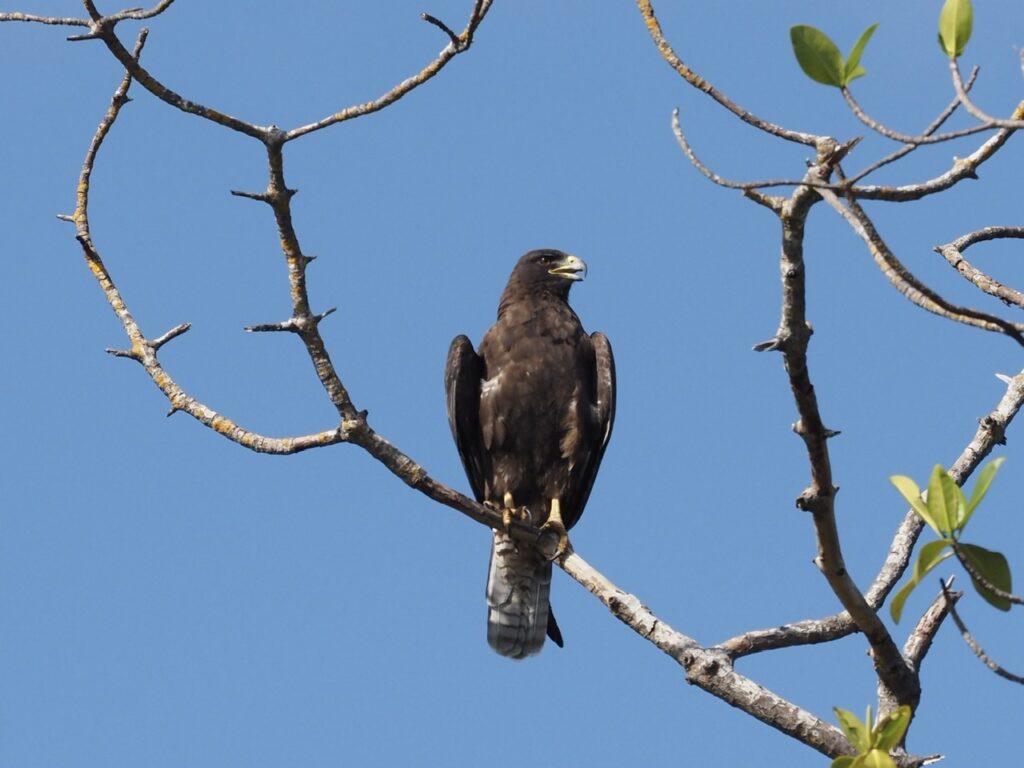
A Galapagos hawk surveys the magnificent landscape.

We walk onto a lava flow where Charles Darwin came ashore. A lizard scuttles past my feet.

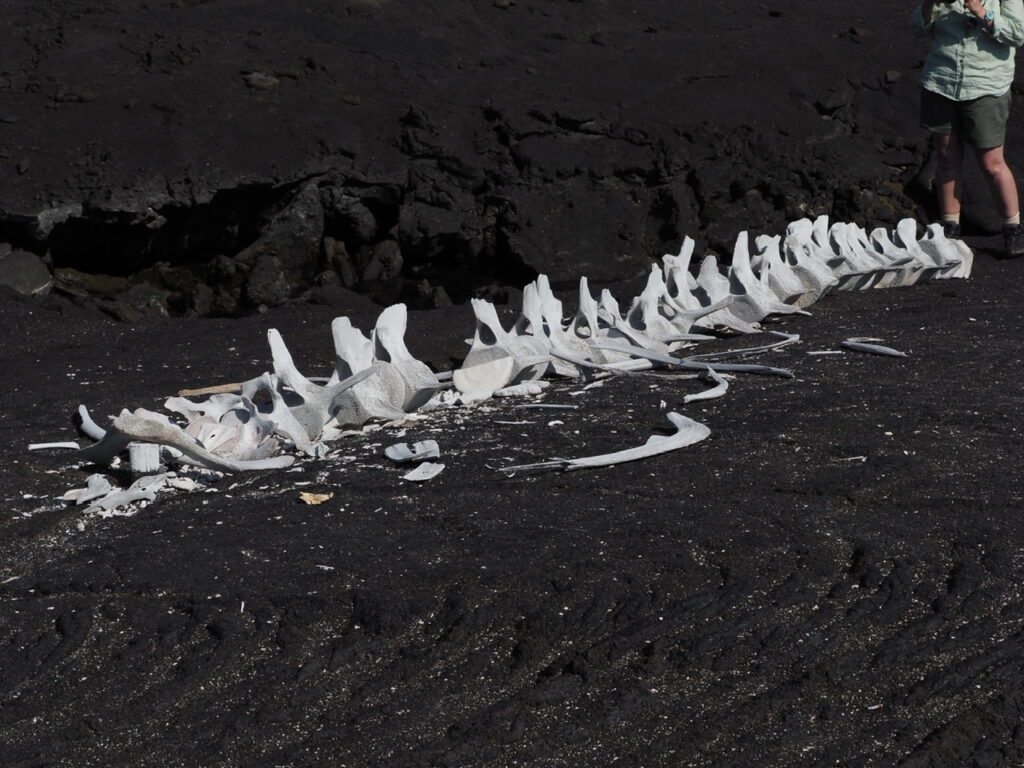
There is the skeleton of a juvenile whale which is interesting. Alexis shows us the bones – an intervertebral disc and the top vertebra where the skull rests.

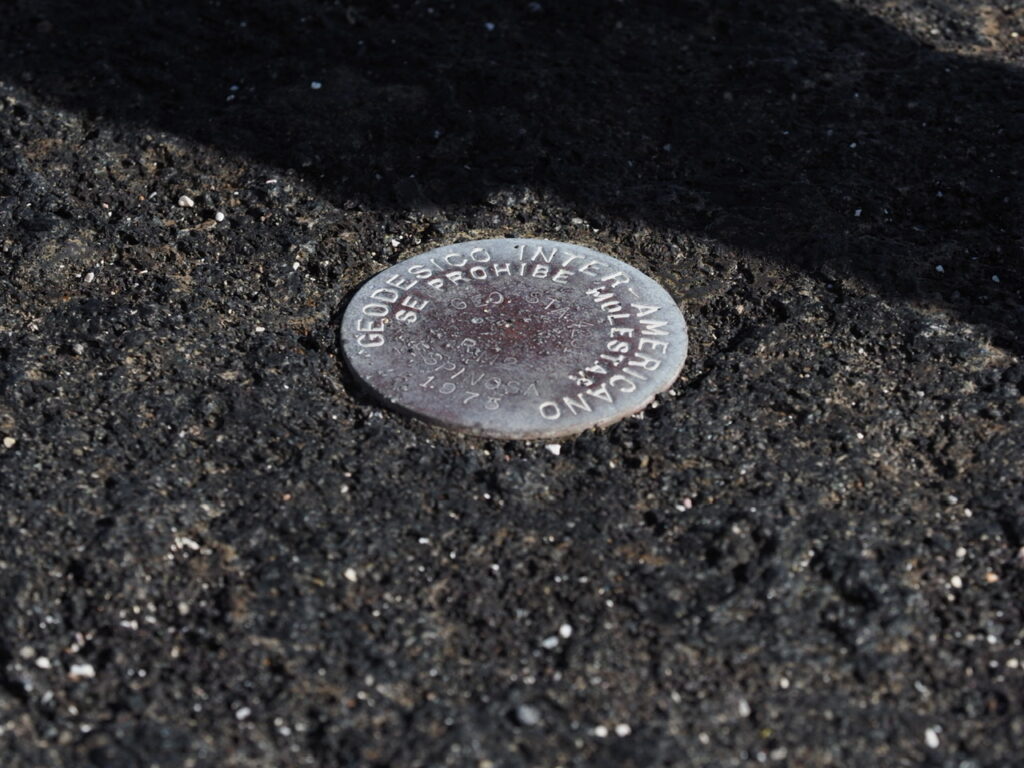
The US are monitoring the movement of the islands and have put down a GPS marker. They have established that the island has moved 6 metres since Darwin first landed here.

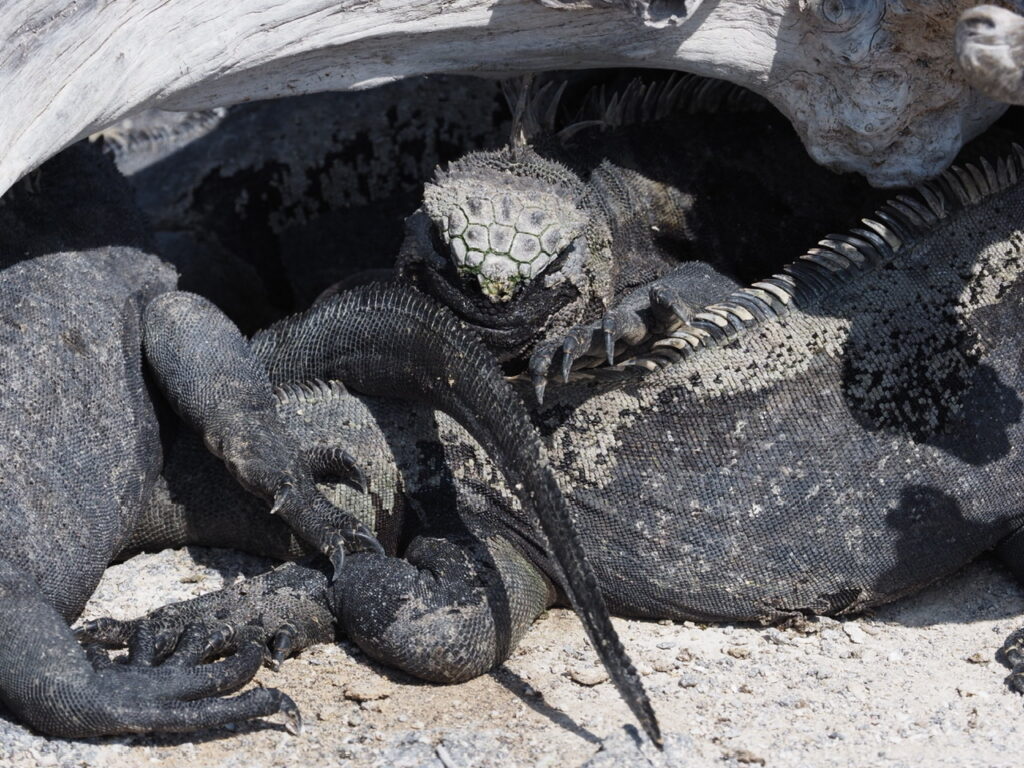
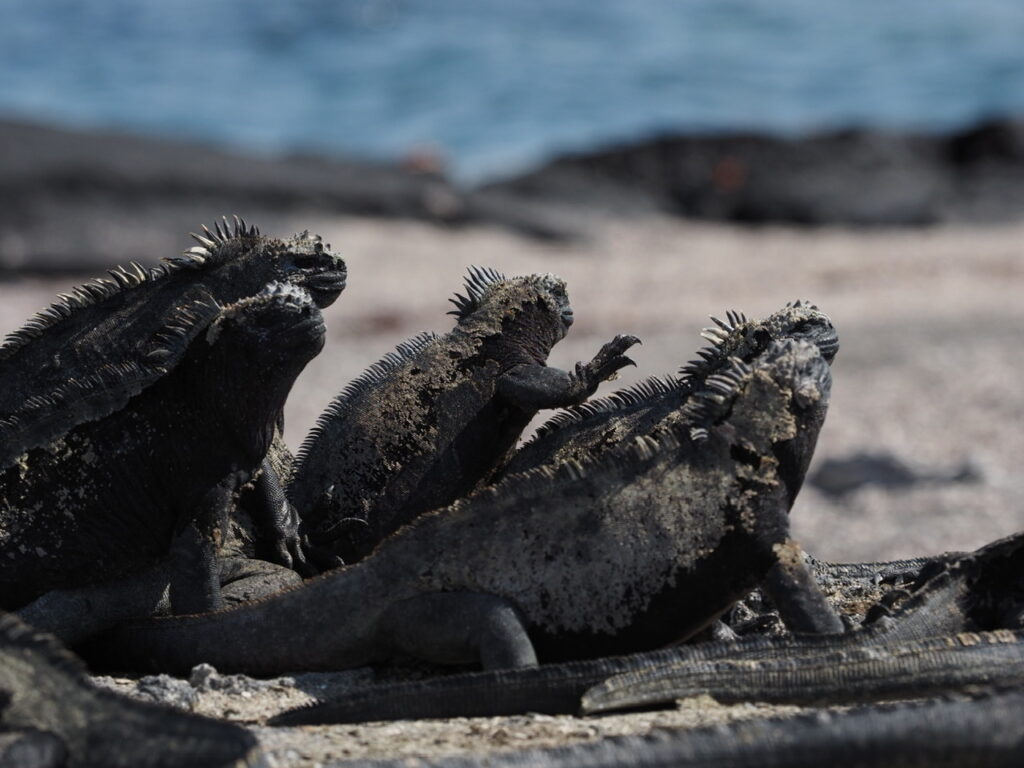
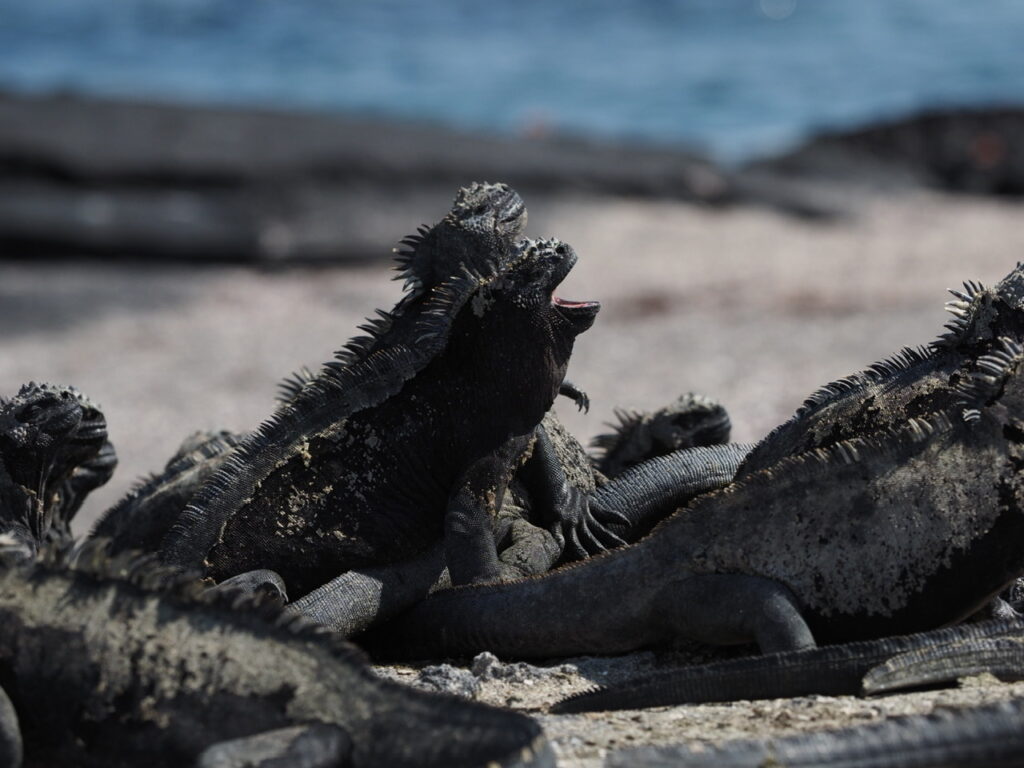
We make our way to the beach where hundreds of iguanas are sunning themselves.

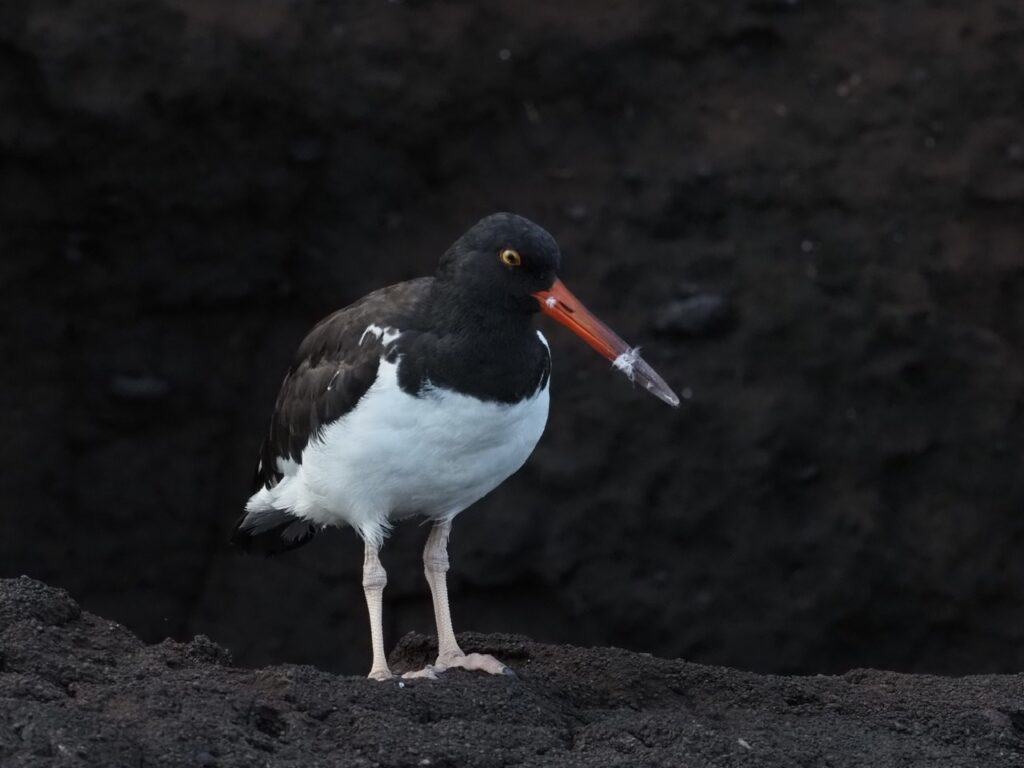
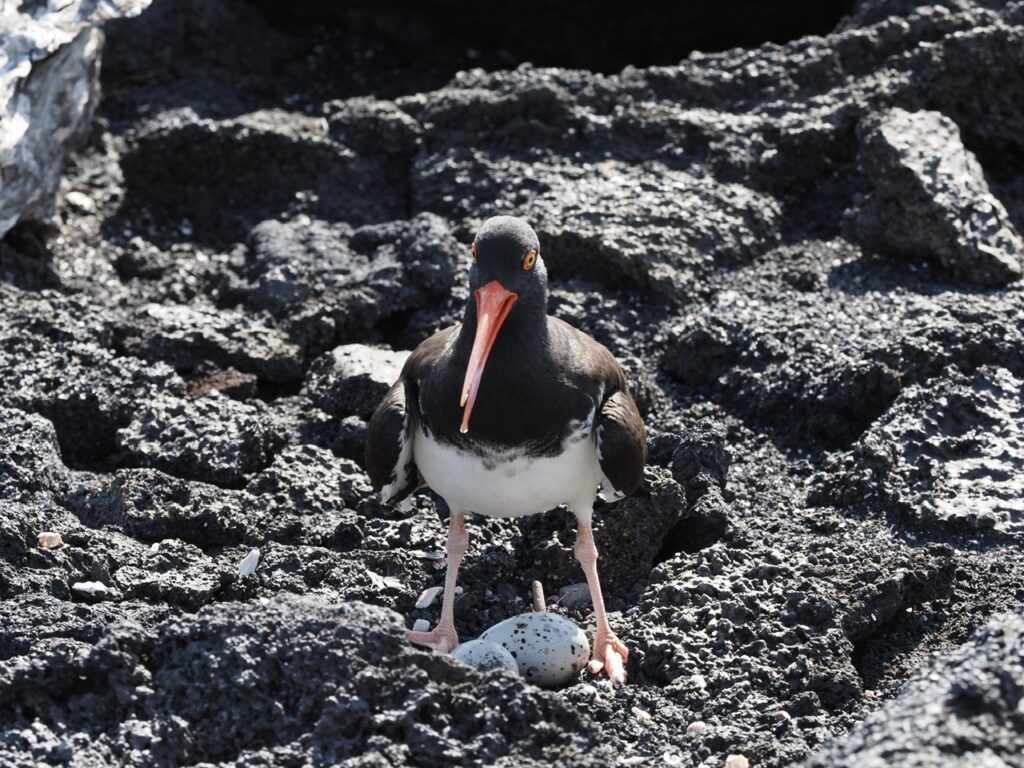
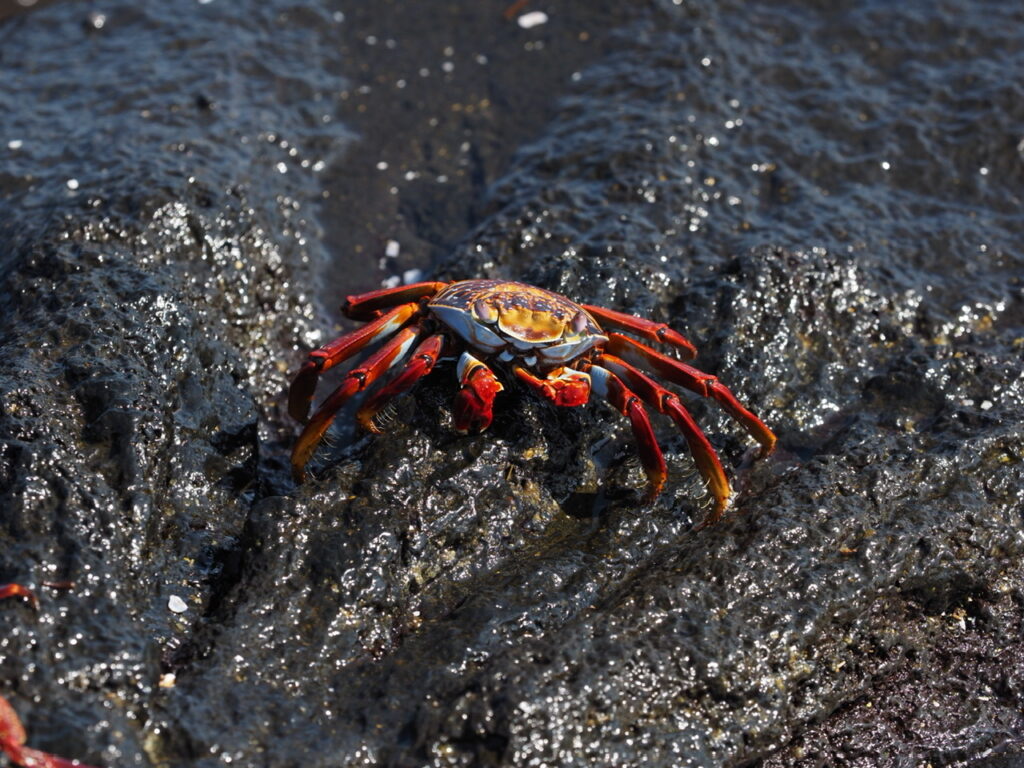
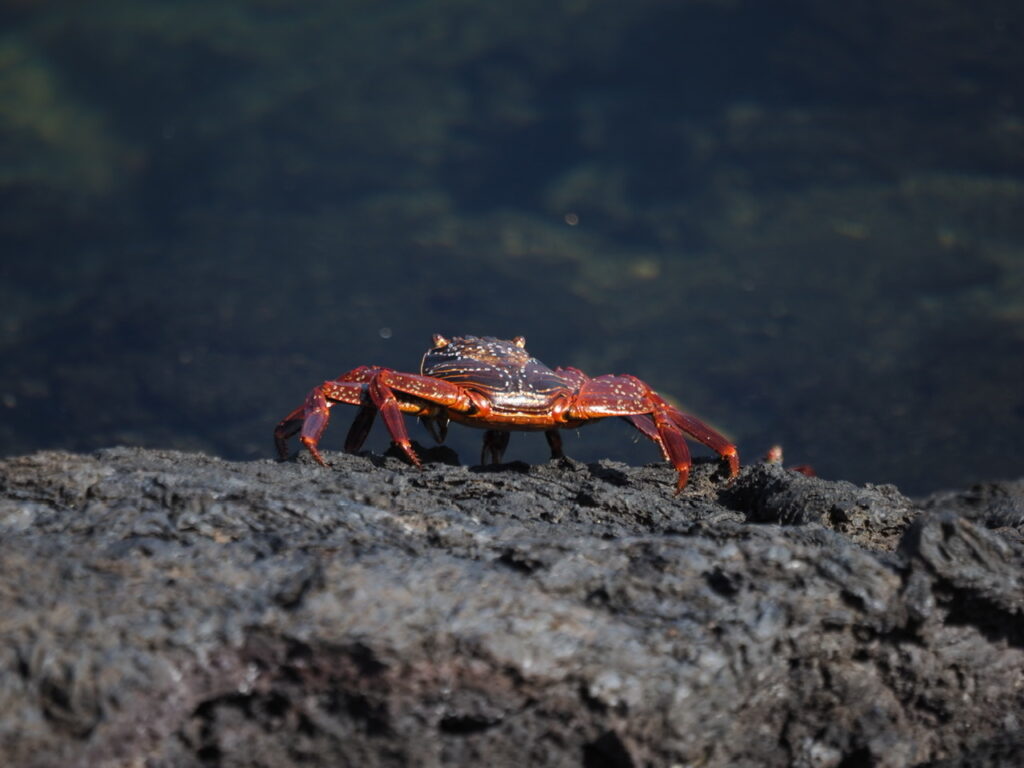
An American oyster catcher guards its eggs and brightly coloured crabs feed amongst the rocks.

Lizards sit on some of the iguanas heads as this is a good spot to catch flies.

Some of the iguanas are now warm enough to enter the sea. If you look carefully you can see one caught in the breaking surf below.

It is exceedingly hot despite the fact that it is only 8 o’clock in the morning. It is an interesting walk and we have lots of time for photography.

We head back to the boat for a quick turnaround and deep water snorkel. I decide to wear a wetsuit and this is a good call. I see some pretty cool things:-

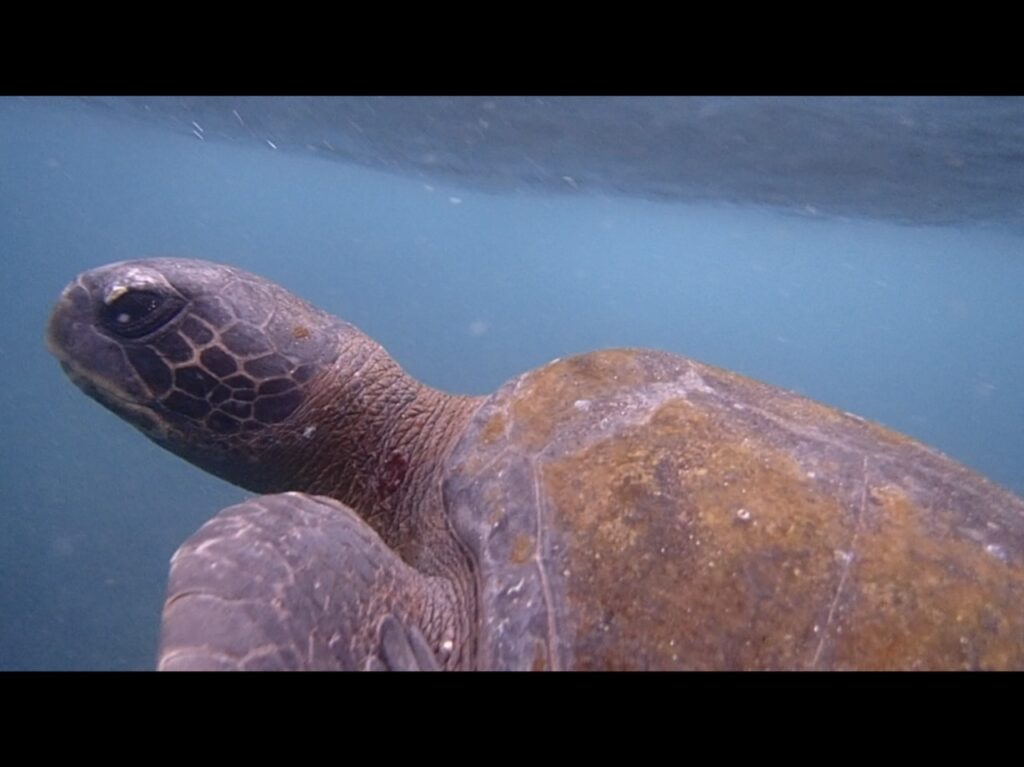
An iguana swimming  underwater, a sea lion circling me several times, huge giant turtles which are much too interested and literally swim within inches of my face. It is actually quite disconcerting to have them invading my personal space. There are loads of fish, including bump-head parrotfish, beautiful king angelfish, large shoals of grunt, blennies and lots of small fry. There is a reasonable swell so we need to pay attention as we swim along the rocky coastline.

We motor up to the northern tip of Isabela whilst we eat lunch. Our anchorage is next to impressive towering cliffs at Punta Vicente Rica. The rock strata is amazing and you can really see the different mineral layers.

We then have another deep water snorkel. This time the swell is really extreme, moving us 3-4 metres as the waves surge in. Visibility is poor and in my view being close to the rocks is dangerous. Staying off shore it is deep and hard to see much. Huge turtles join us and at one stage I am sandwiched between two with one actually resting on my back! Insane!!

We head back and are greeted with hot chocolate. This is very welcome. I am cold despite the 28C temperature. The skies are cloudy today and it has rained lightly. The humidity keeps everything damp all the time so when the sun is not shining it can feel cool. 

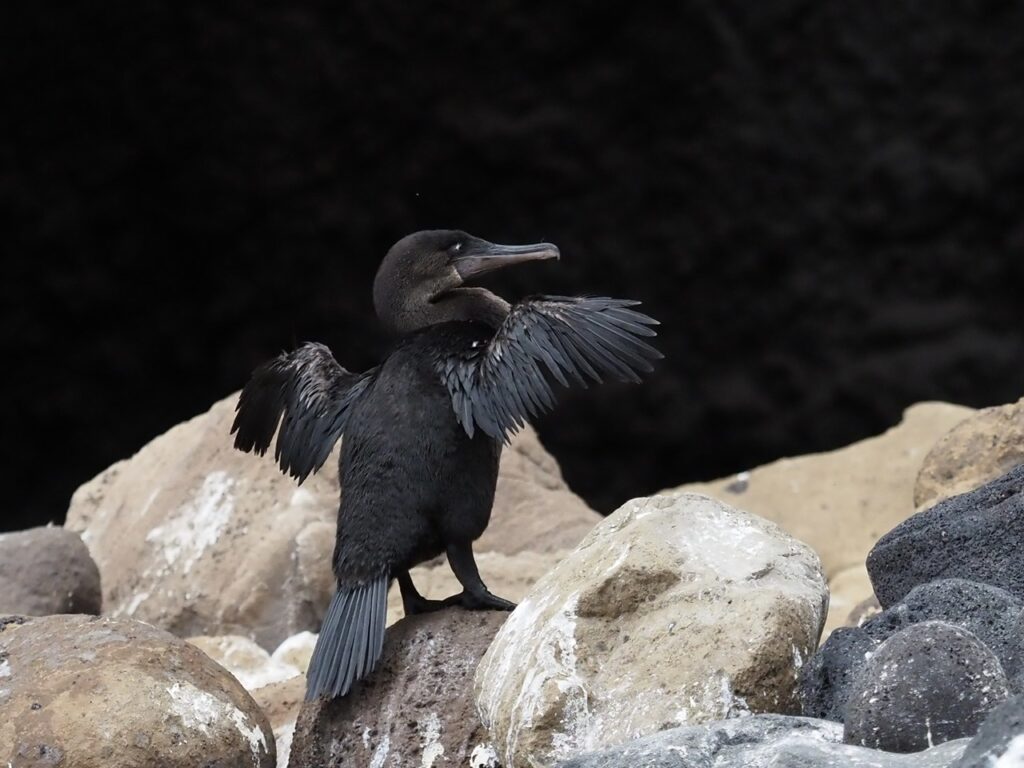
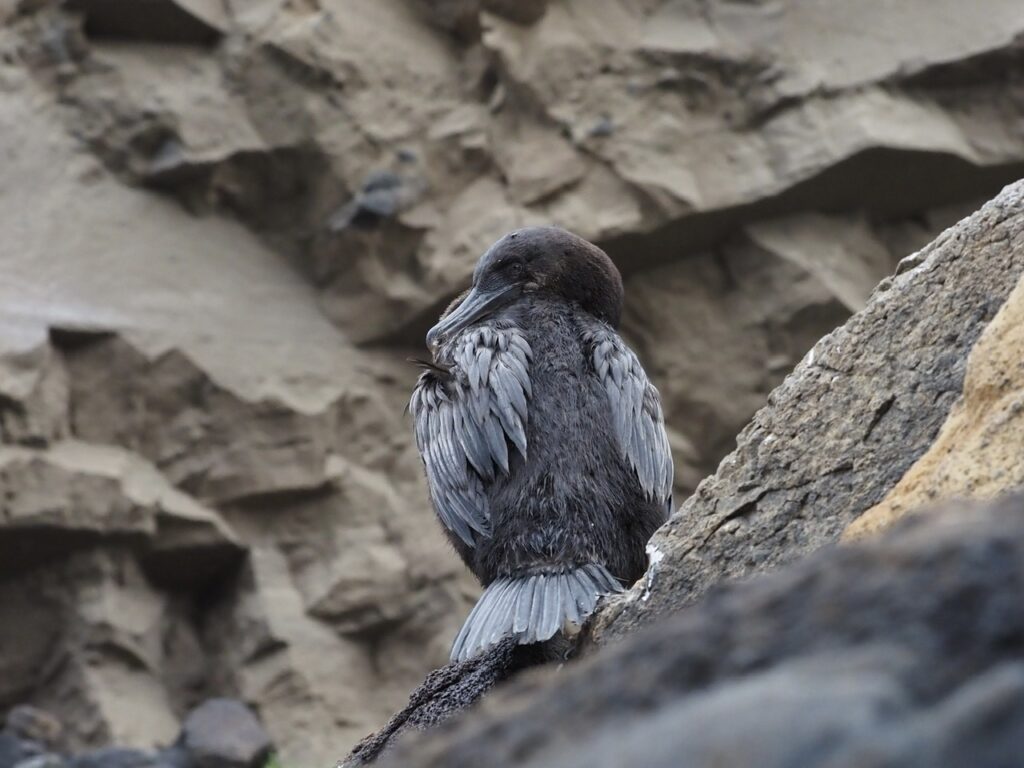
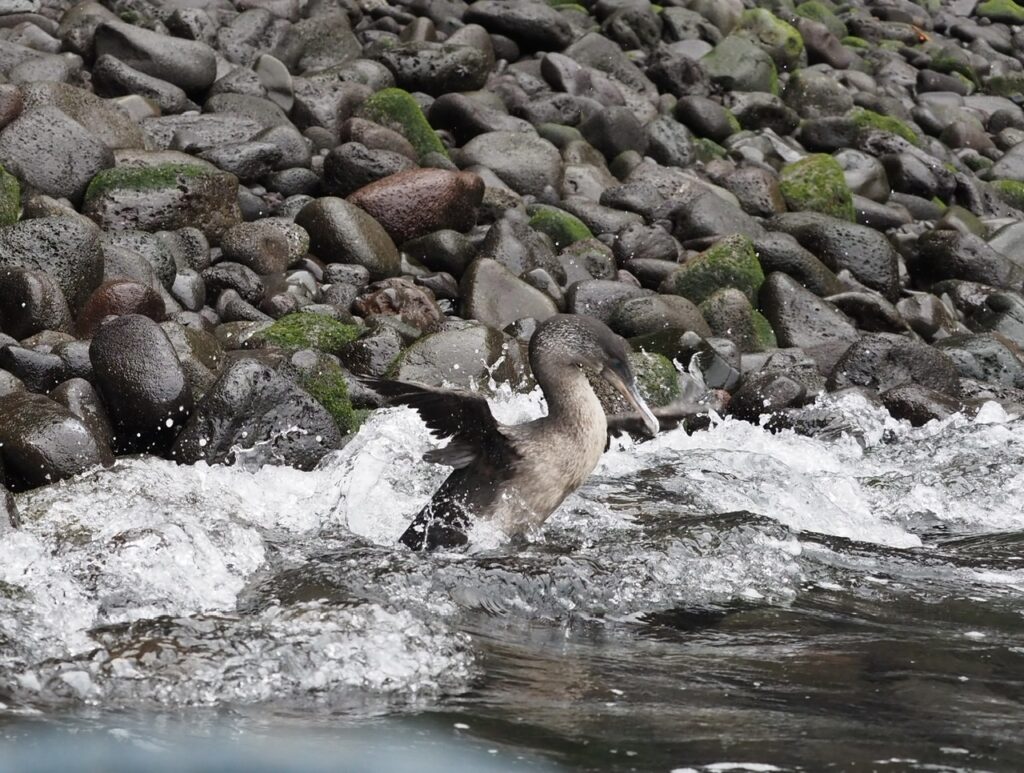
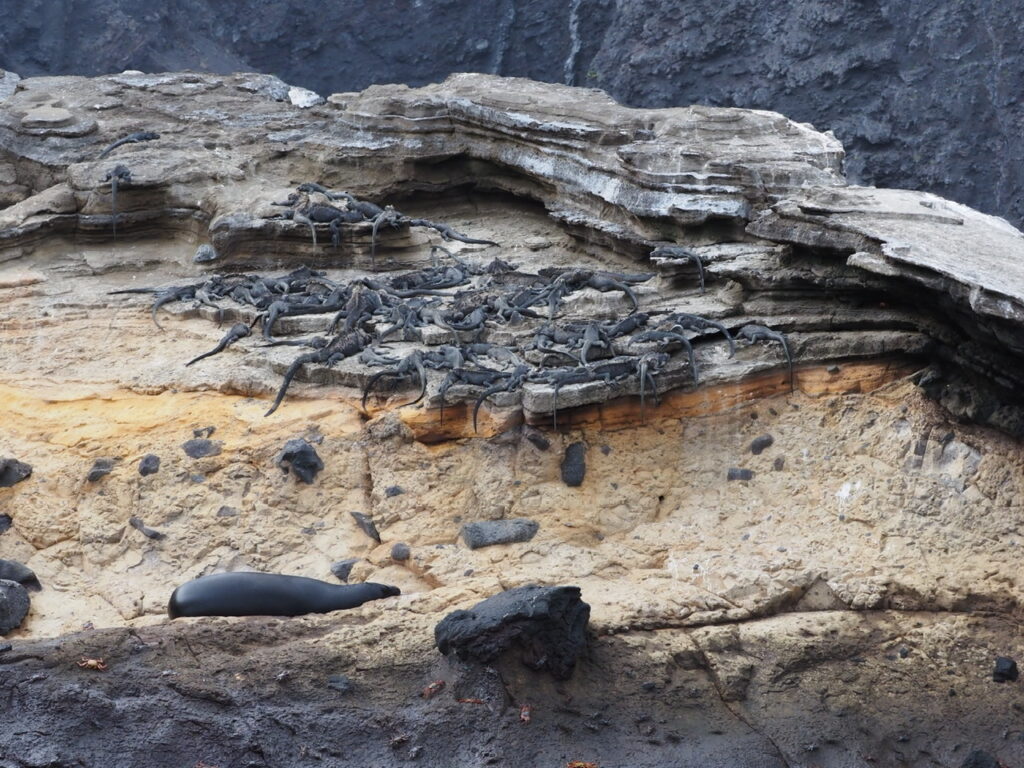
We have a panga ride along the shore. I sit in the front footwell in the hope of better photos but it is hard. The swell creates a lot of movement and I need to be very fast focussing. There are sea lions, flightless cormorants, blue-footed boobies, brown noddys, pelicans, iguanas and the ever present turtles. Marine iguanas cling to any available ledge.

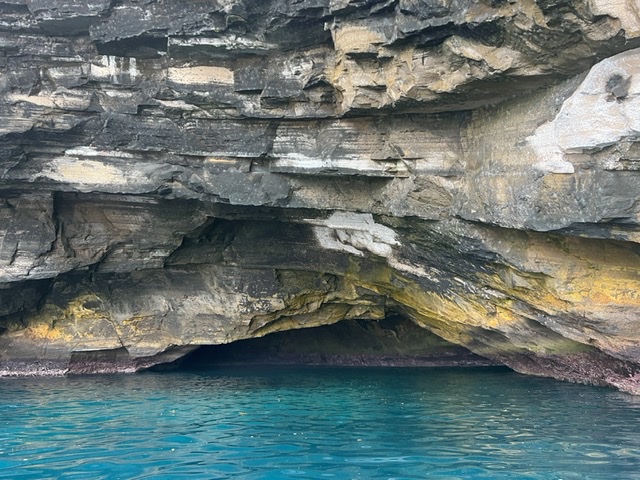
There is a cave that we motor into. Boobies and noddys nest on the edges. We feel like we are in the target area and, as I take photos, someone splashes me with water and says ‘Oh no! That’s lucky” I don’t re-act but am relieved to find out that it was just water on my head!

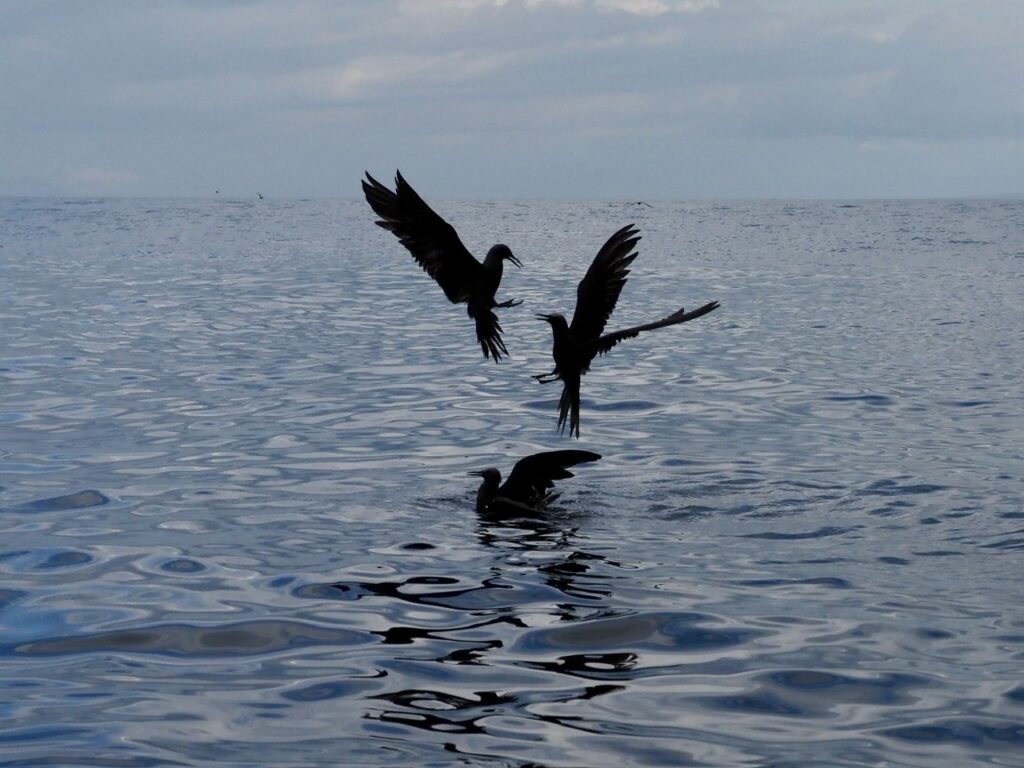
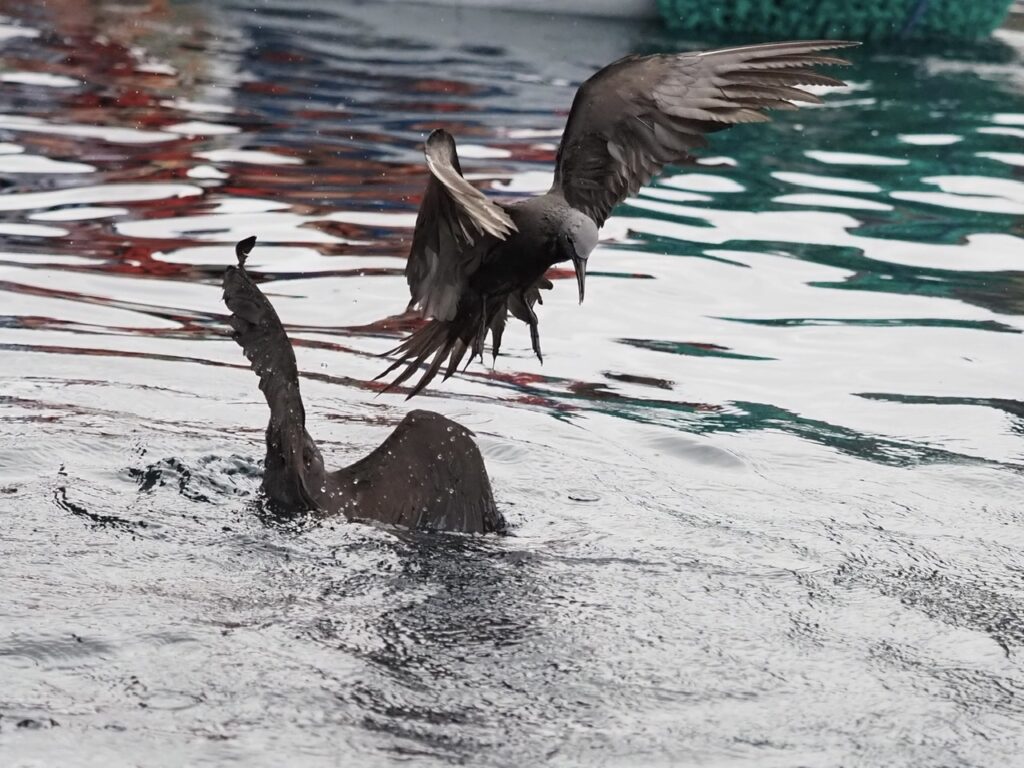
As we return to the boat a vicious fight breaks out between the noddys.

We set sail for a long journey around the northern tip of Isabela. This involves crossing the equator. We stand on the bridge so we can film 0.00.00 on the instruments. Andreas – a guest’s son, is allowed to take the helm and his sister sounds the horn. I video to capture the exact moment but the screen goes from .001S straight to .002N.

We are given pirate hats, rum and have a celebratory dance to placate Neptune, together with a certificate to prove our passage.

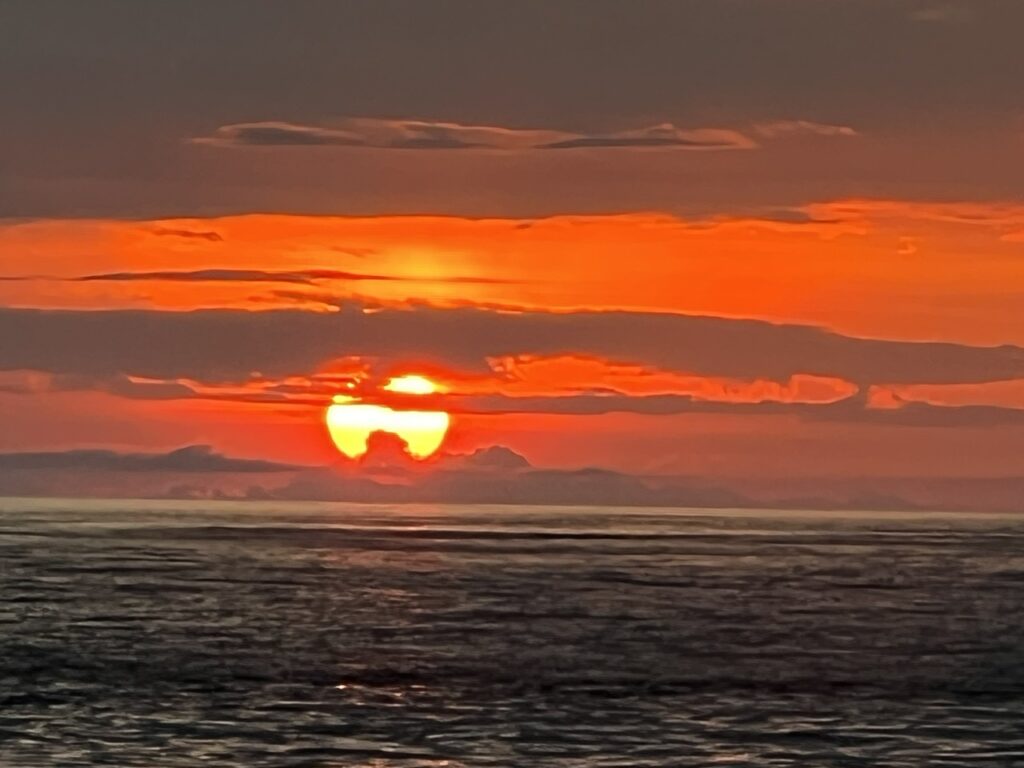
We then watch a gorgeous sunset over the equator.

Moreno Point and Tagus Cove, Isabela

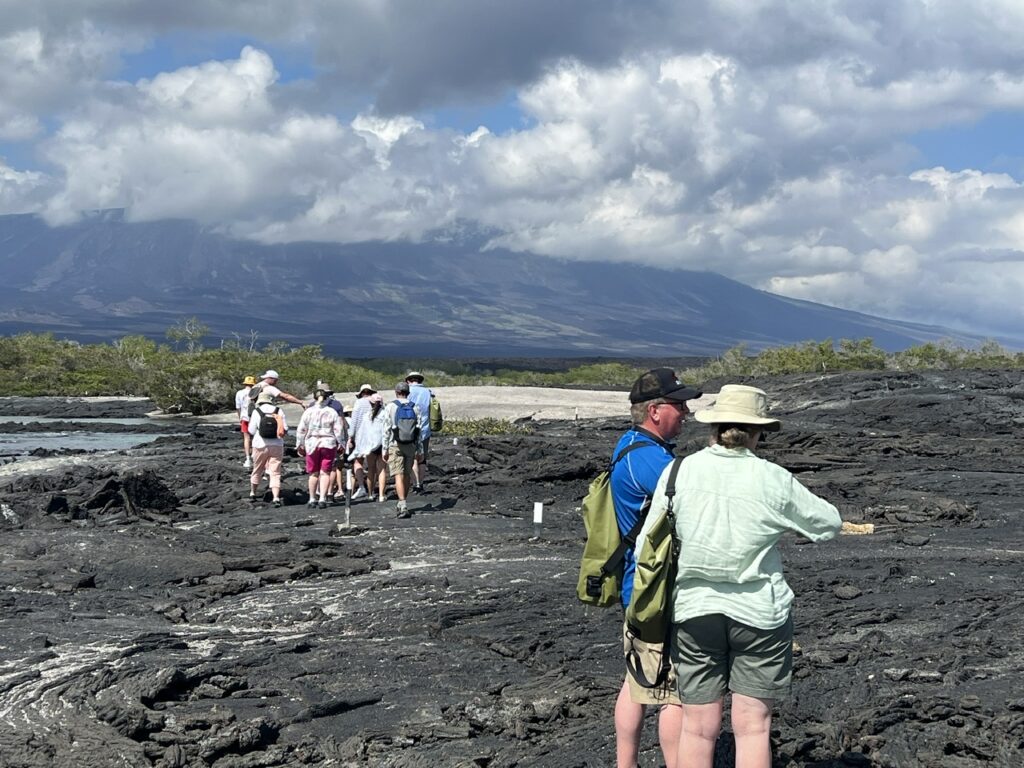
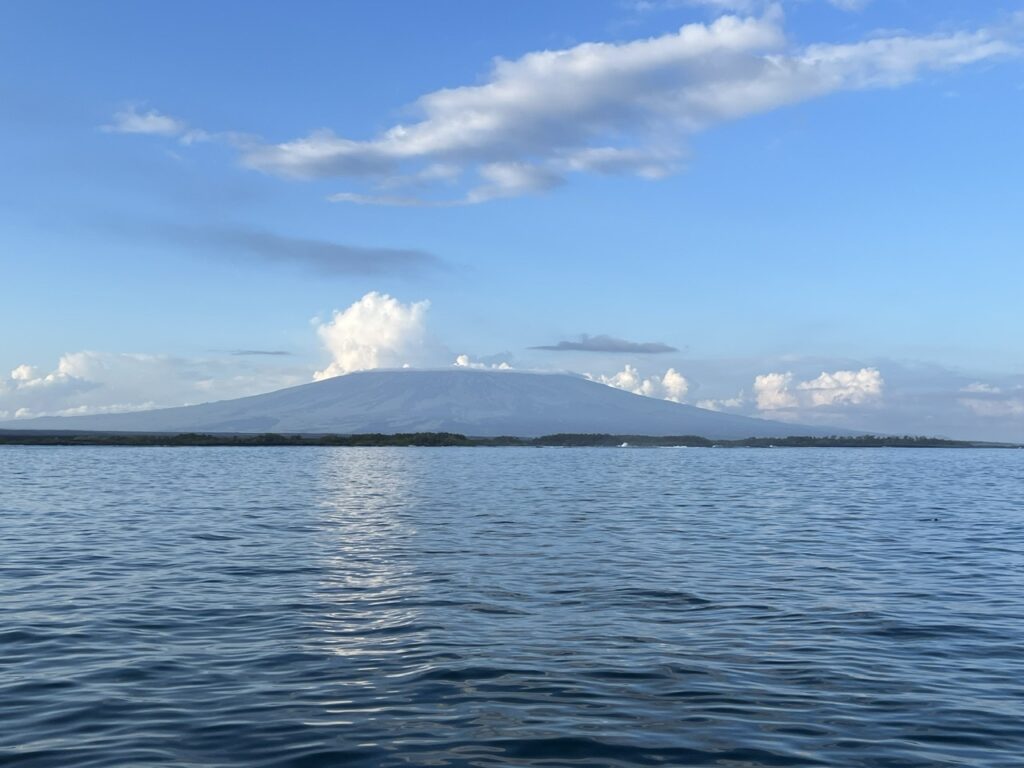
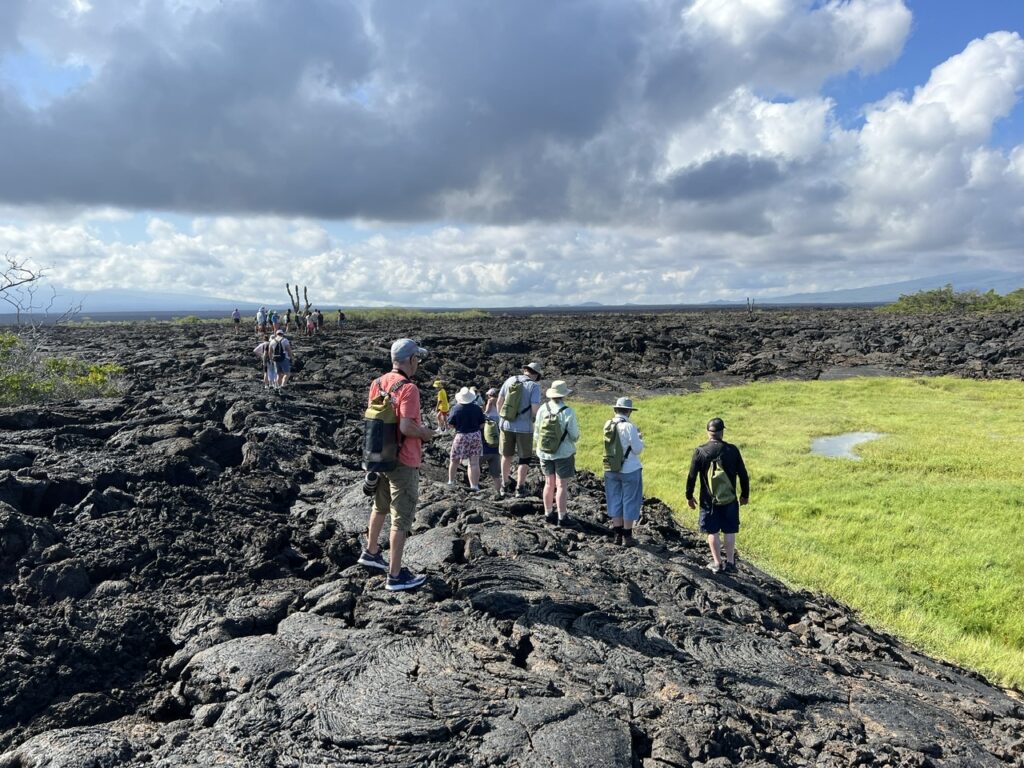
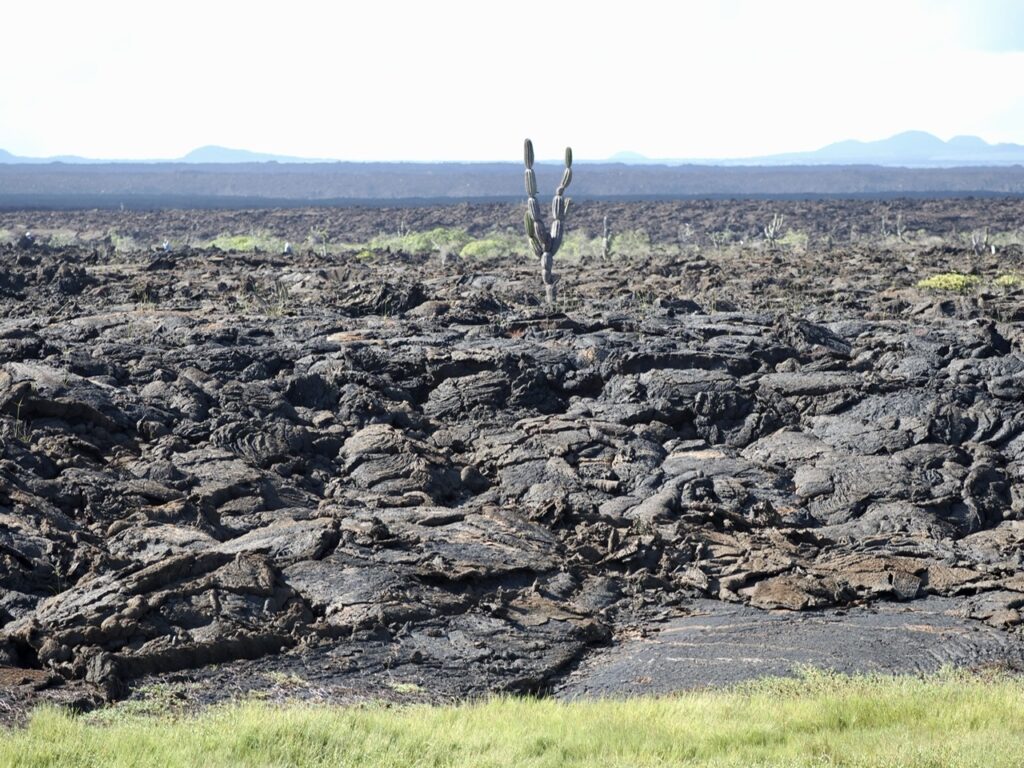
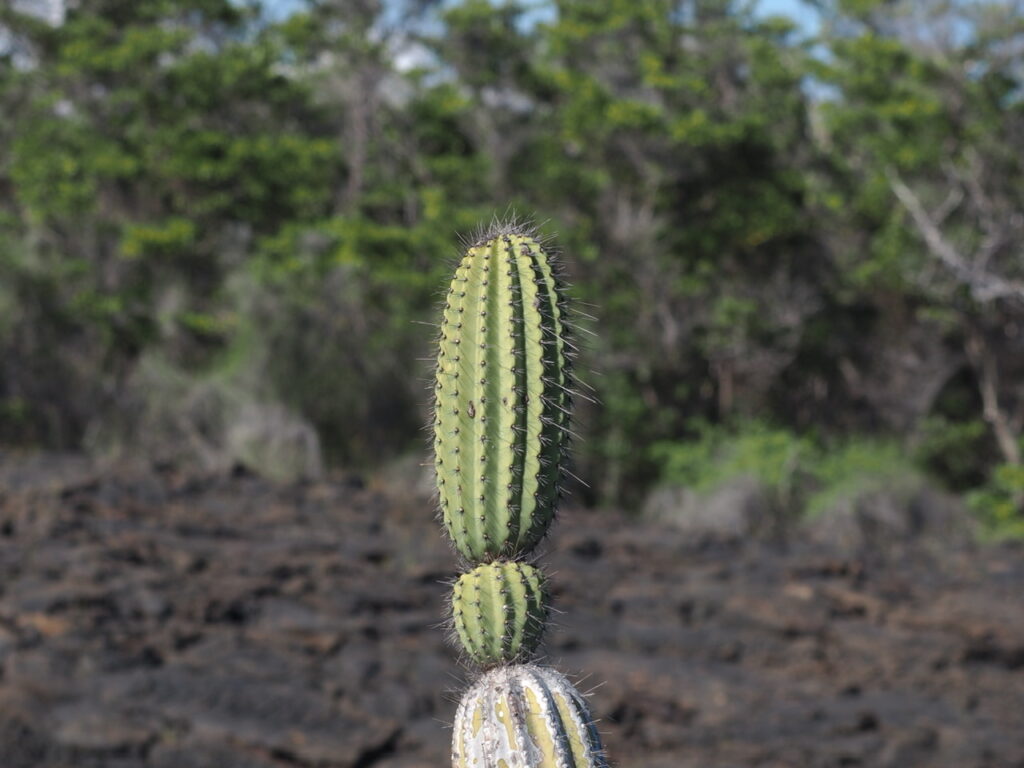
Overnight we travel to the south-western coast of Isabela. We anchor at Moreno Point and go ashore for, we are told, a dry landing. Well it is dry if you get it right, but there is no dock. The pangas carefully manoeuvre up to the rocky shoreline and we carefully disembark onto the sharp and uneven lava flow. I am very glad I decided to wear my walking boots. The terrain is uneven, with jagged lava and loose cracked plates. It looks like a lunar landscape. Unlike anywhere I have ever been before. Occasional cactus, grasses and scrubby trees have somehow managed to take root in places.

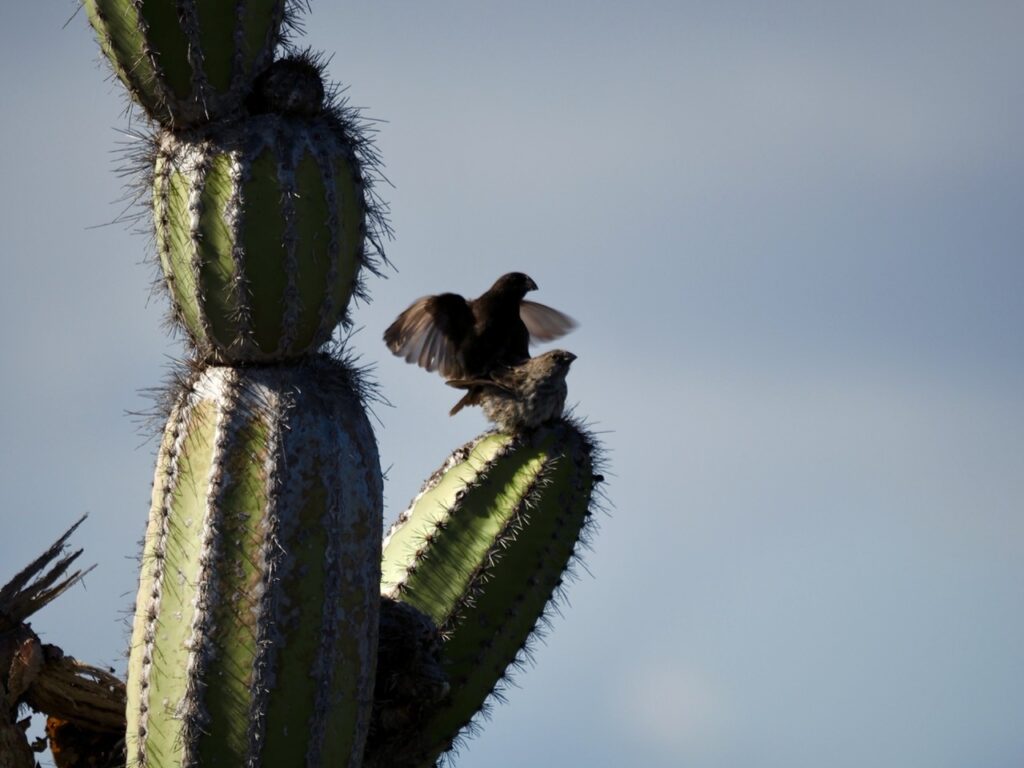
We see some Darwin Cactus Finches….

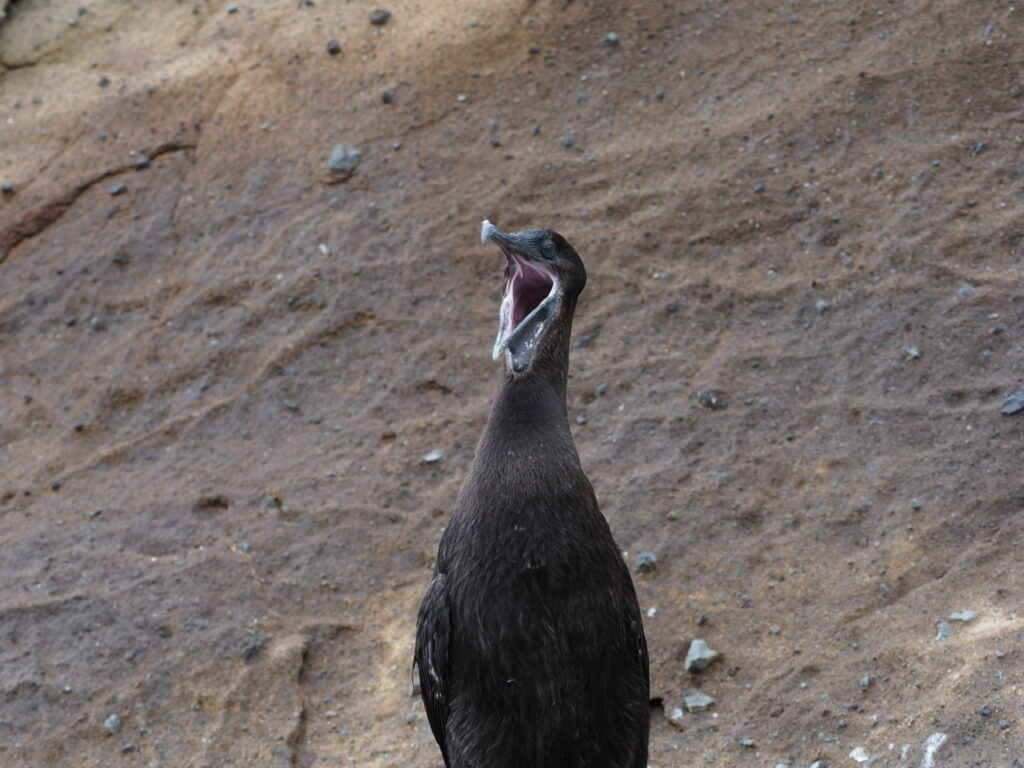
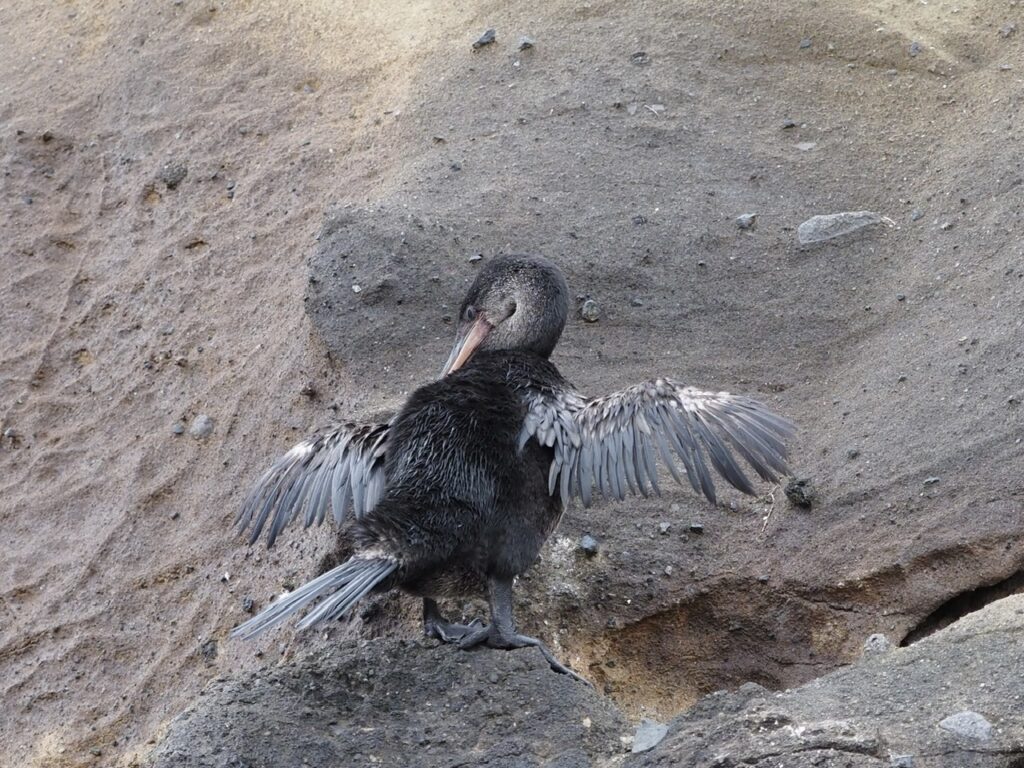
…. and are given a geology lesson on volcanoes. On the way back we see flightless cormorants and penguins.

Turtles abound as do sea lions which are continually popping up around the panga.

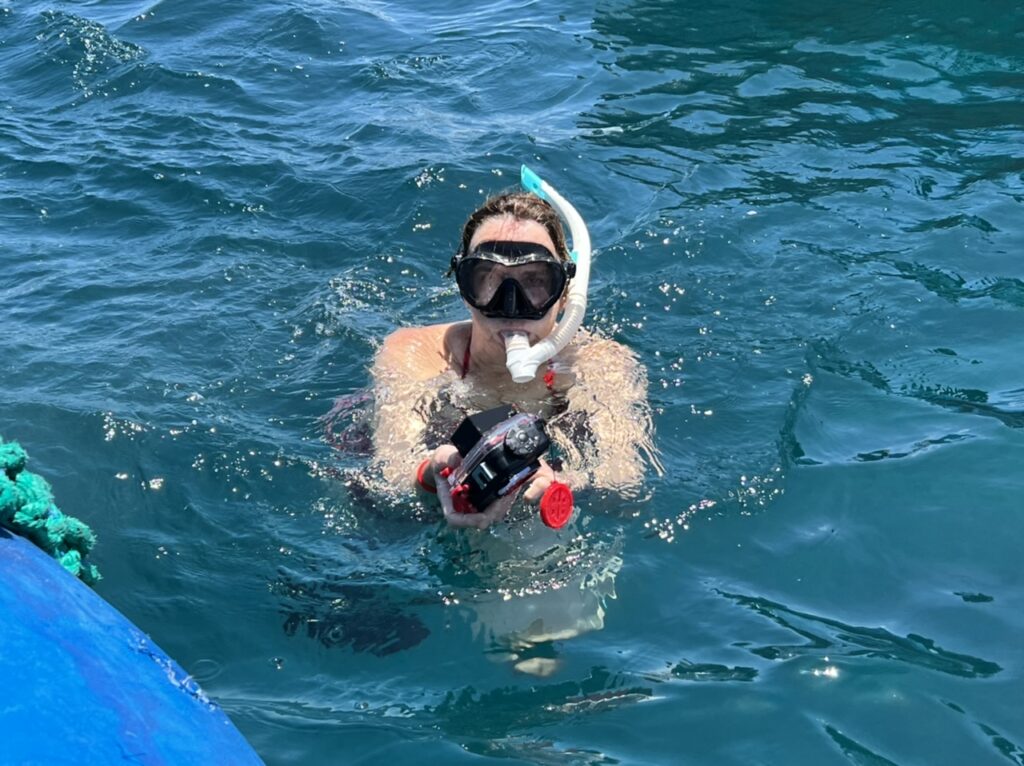
We go back to the boat and have 20 minutes to change before going snorkelling. I decide to not wear a wetsuit but get a shock when I slide off the side into the water.

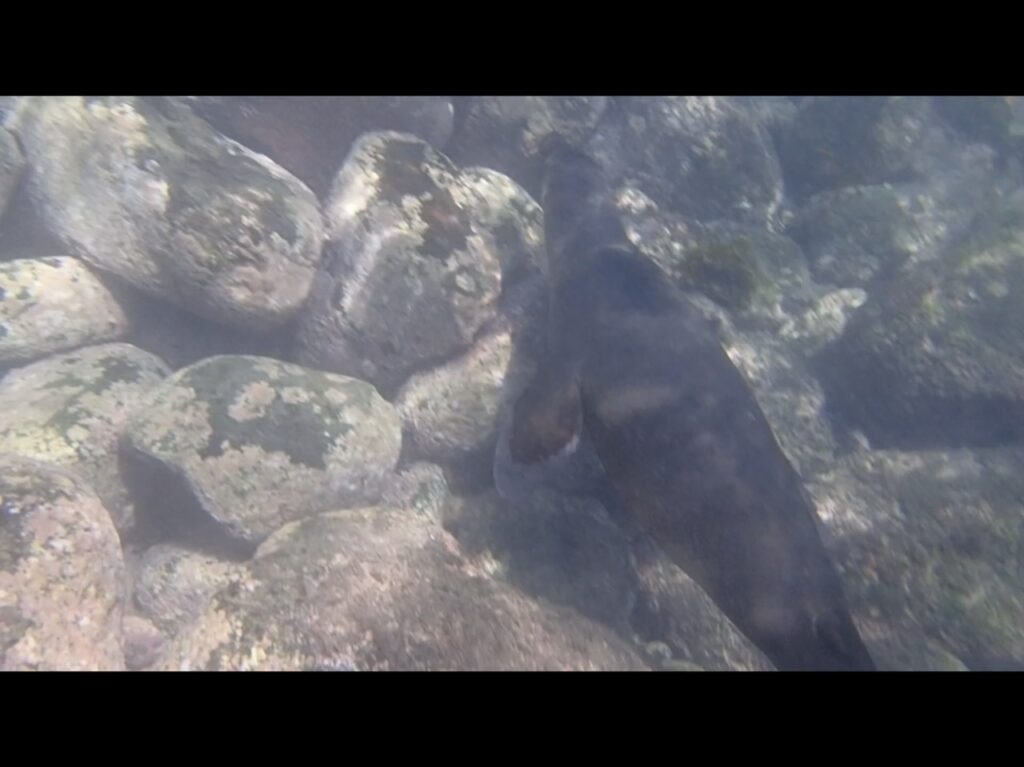
It is way colder than yesterday. There are thermoclines and the water close to shore is much warmer. I am filming a large shoal of fish when a sea lion photobombs the footage (extract photo from video below)

How cool. I am thrilled. It was only a brief encounter but it is excellent footage. There are loads of turtles. The weather is clear and I have good video of them too. The sea life is abundant and wonderful to experience.

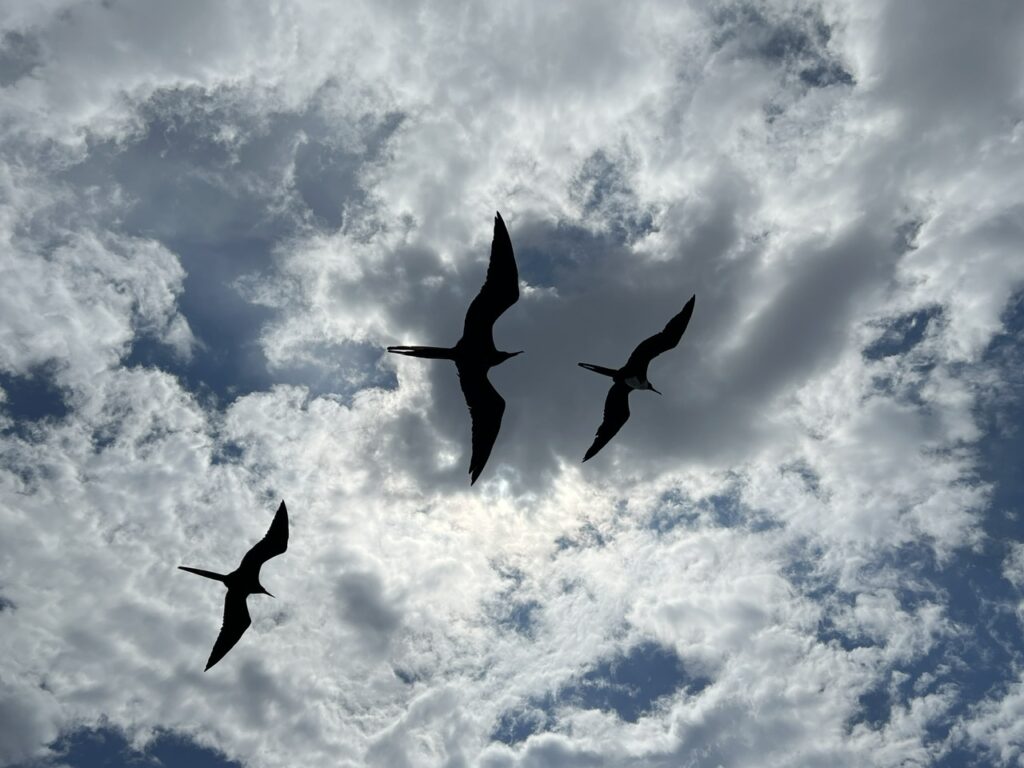
Lunch is huge and consists of an Ecuadorian speciality of tuna in a spicy sort of soup. It was pretty filling and yet there is more to follow. It turns out this was the starter and the main course was a choice of fish or tiger prawns, rice and salad. We are certainly not going to starve on this trip. Whilst we eat lunch, the boat weighs anchor and we motor up the coastline to Tagus Cove. Somebody shouts dolphins and we rush outside, but in fact it is sea lions, behaving exactly like dolphins and swimming in formation and jumping out of the water as they swim. We are also treated to frigate birds taking advantage of the air currents above the bow. They hover and soar above our heads on the top deck.

Initially there is only one bird but shortly it is joined by several others. They squabble in mid-flight and soar back and forth above our heads literally feet away. They probably stay with us for at least an hour and it is just a completely astonishing experience.

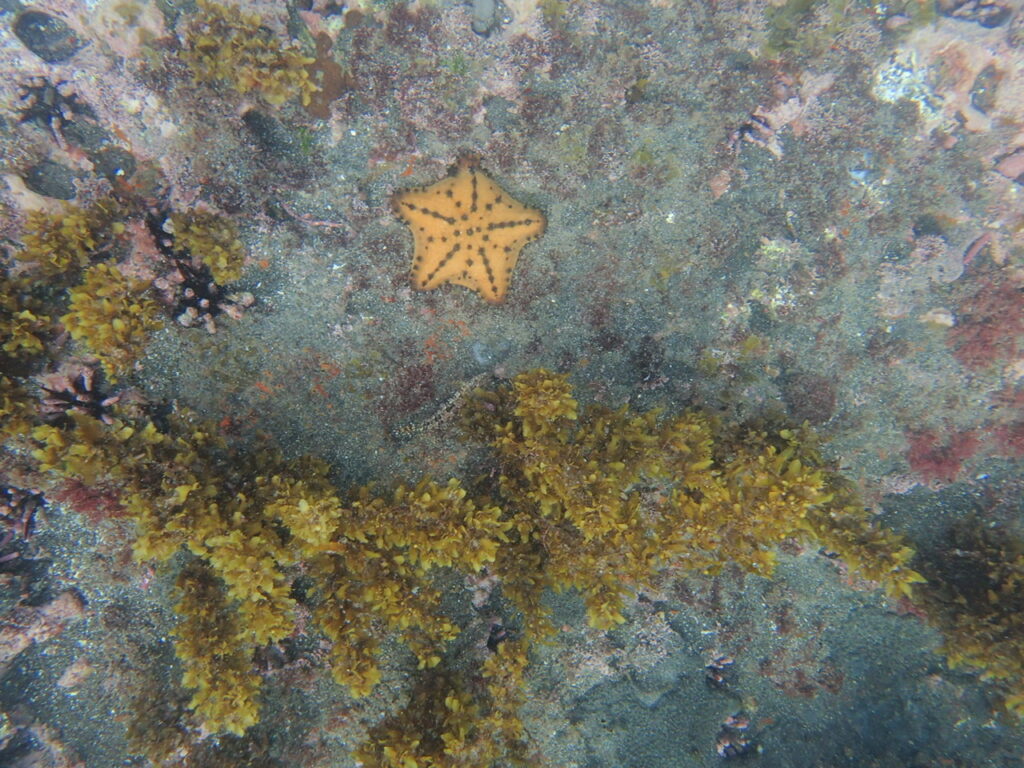
We set anchor at Tagus Cove and again go snorkelling. Jane has decided to try and snorkel again this afternoon. I gave her a lesson a couple of days ago in the shallow water and hope that will enable her to be more confident in the deep water. She is wearing a wetsuit so that will aid buoyancy. Fingers crossed. I also decide to wear a wetsuit, as I believe the water will be cold. In fact, it was a reasonable temperature, but as we are close to the rocks and there is a strong swell , the suit offers a little protection from potential grazes. We slip off the side of the boat. There is a strong swell which washes us several feet towards the rocky shoreline before pushing us back to where we started. There are masses of turtles they come very close to us and equally are pushed to and fro in the strong currents. There are eight of us in our tender and we swim largely as a group along the shoreline. There are lots of fish of all sizes and varieties and a chocolate chip starfish.
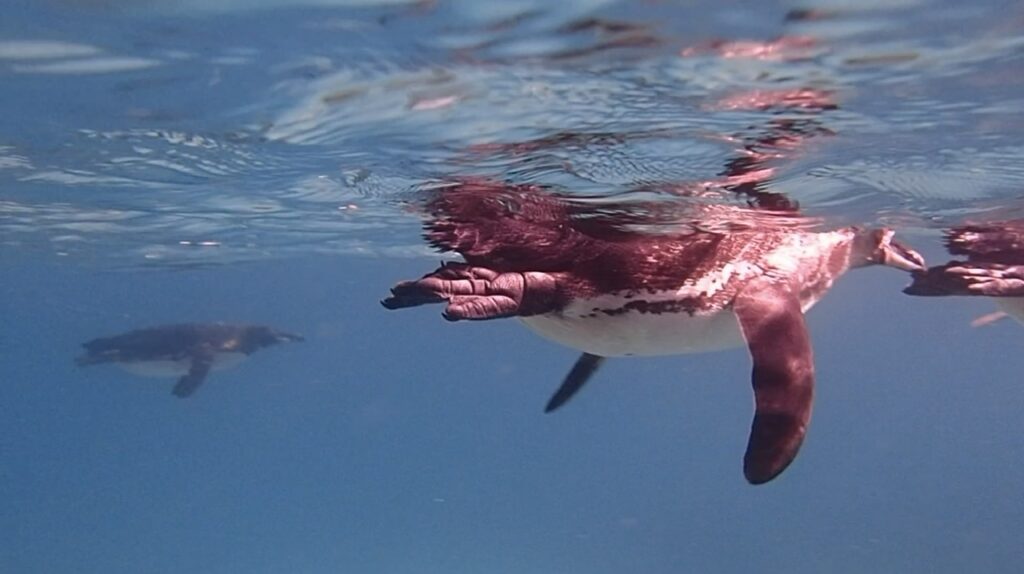
Then something shoots past me. Wow! It’s a penguin chasing fish. I cannot believe it. I really did not think this would be something that I would see, though I very much hoped I would. A second penguin appears, a large turtle swims  directly beneath me and then a large white tip shark nonchalantly cruises past my right shoulder – pretty much within touching distance. My camera has steamed up so no photos but AMAZING. Just AMAZING!!!!!

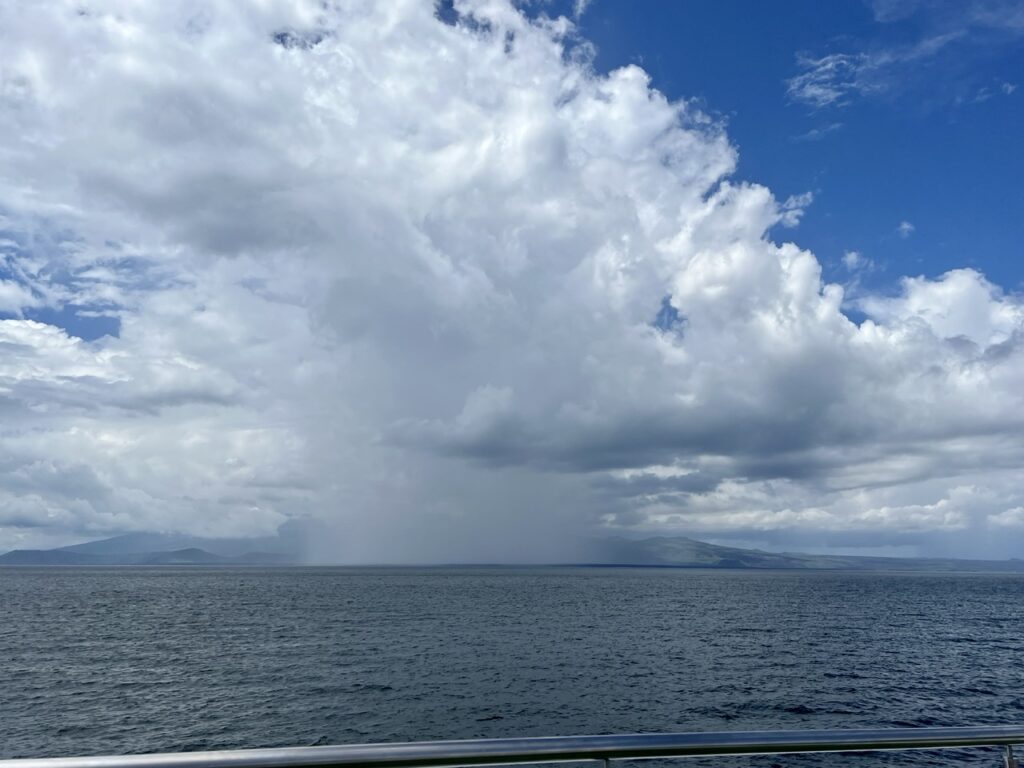
After the best part of an hour we return to our boat and are welcomed with hot chocolate and biscuits. The heat has built up and a heavy rain shower looks like it is coming our way.

We have a quick change before setting out again in the panga to cruise along the coastline in the hope of seeing penguins and blue-footed boobies.

We are not disappointed and also see pelicans nesting with young chicks, flightless cormorants, sea lions and noddys. Iguanas rest on the ledges and sally lightfoot crabs scavenge on the wet rocks.

Sea lions again join us, manta rays make enormous jumps in the distance and then a most amazing rainbow appears above the sea.

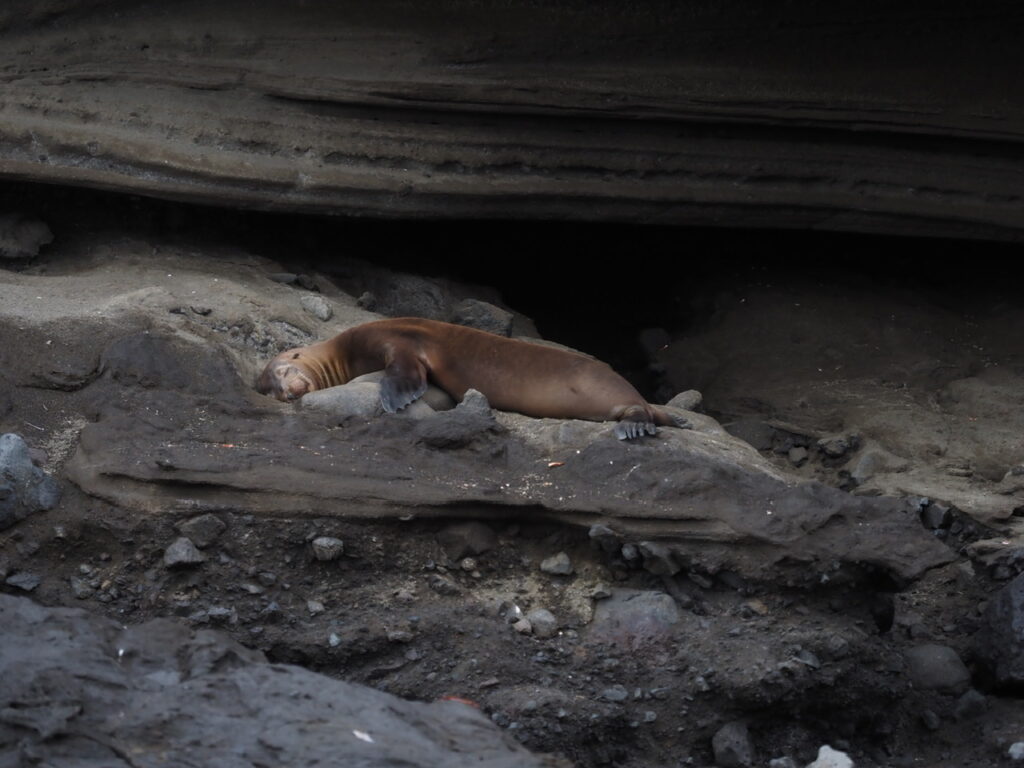
Could this day get any better? Dinner is sushi which is very good. We then go on deck to see a sea lion asleep on the stern decking. I have no idea how it managed to get aboard. It was not at all bothered by us watching it.
Page 11 of 34

Powered by WordPress & Theme by Anders Norén